

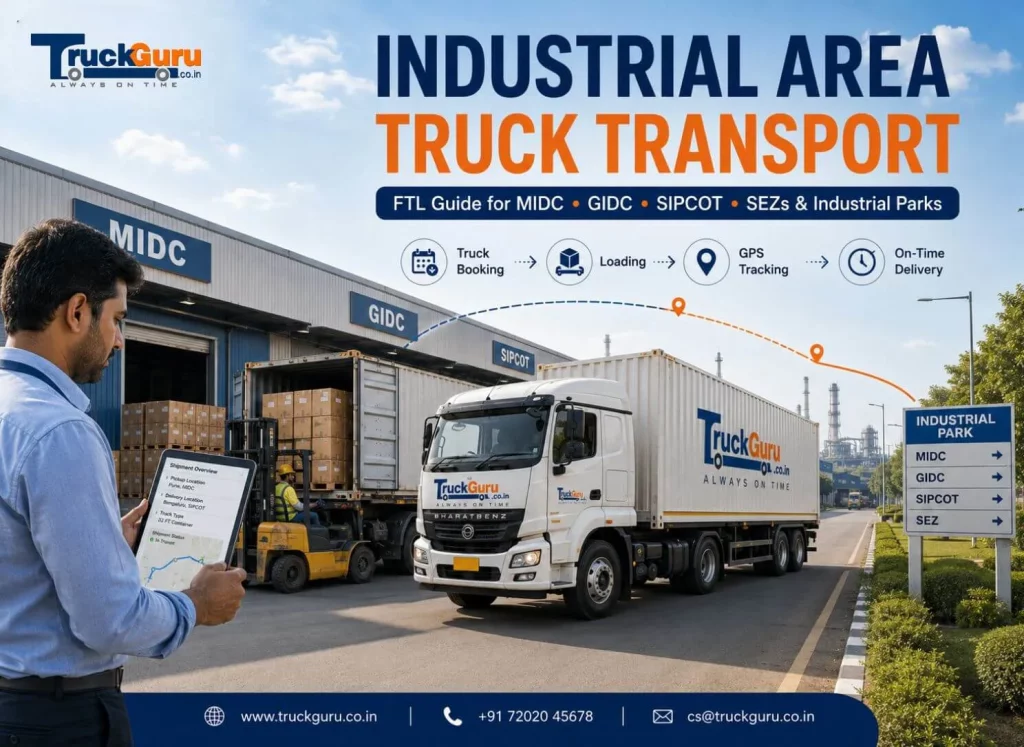
Industrial Area Logistics Guide: Truck Transport for MIDC, GIDC, SIPCOT, SEZs and Industrial Parks in India
The truck arrived at Chakan MIDC Plot B-14 at 7:40 AM. Heavy vehicle entry opens at 8:00 AM. Twenty minutes is nothing — except this driver had come overnight from Nagpur and had no idea about the timing restriction. Three more trucks queued behind him. By 8:30 AM, when the weighbridge finally cleared the first vehicle, the loading supervisor was already on the phone explaining why the 9:00 AM dispatch window was gone.
Industrial Area Truck Transport India: Quick Summary
Industrial Area Truck Transport India: FTL truck rates from Rs.26/km for MIDC, GIDC, SIPCOT, and SEZ dispatch. Sizes, corridors, documentation and tips for.
That lost window cost more than the Rs.4,200 freight rate. The downstream buyer’s inward dock had a 12:00 PM cut-off. The truck arrived at 1:15 PM. Goods sat outside overnight.
This is the specific problem that industrial estate freight creates. Moving goods out of a notified estate — MIDC, GIDC, SIPCOT, or an SEZ — involves gate protocols, weighbridge queues, plot navigation, bay allocation constraints, and vehicle movement restrictions that most general transporters have never been briefed on. Getting all of it right requires preparation that starts before the truck leaves the origin city.
This guide covers FTL intercity truck transport from India’s major industrial estates. It is written for plant managers, procurement heads, and dispatch supervisors who move B2B commercial cargo on a scheduled basis.
What Makes Industrial Estate Dispatch Different from a Standard Factory Pickup
A factory on a standalone commercial plot and a unit inside a notified industrial estate operate under entirely different logistics rules. The estate is governed by its development body. Every vehicle entering obeys those rules, regardless of what the consignor and transporter have agreed between themselves.
Gate entry documentation is more demanding than most people expect. Drivers must carry the vehicle’s RC and fitness certificate, a valid licence, and the transporter’s copy of the LR. At some MIDC phases and all major SEZs, the transporter must appear on a pre-approved vendor list maintained by the estate security office. If the transporter is not on that list, the truck gets turned away — even if every document is in order.
Plot numbering is the other thing that catches drivers. MIDC Chakan runs across six phases with separate plot numbering series in each. GIDC Vapi is split between GIDC Vapi and GIDC Sarigam, two adjacent estates with different gate entries and non-sequential plot numbers. A driver who has only the company name on his trip sheet will lose 20 to 30 minutes at the entrance. That time comes directly out of the dispatch window.
Loading bay geometry is a constraint that has nothing to do with cargo weight. In certain MIDC zones, smaller plots have loading bays designed for 20ft trucks. A 32ft container at 12.2 metres physically cannot reverse into a bay built for a 7-metre vehicle. I’ve seen dispatch teams learn this only after the truck has already arrived — which means an unloading, a re-book, and a day lost.
Vehicle movement restrictions vary by estate and shift. Some zones prohibit heavy vehicles above 7.5 tonnes during peak inbound hours, typically 9:00 AM to 11:00 AM. Others close outbound movement after 5:00 PM when security shifts change. Booking a truck without checking these windows is the fastest way to miss a departure slot.
State Industrial Development Bodies and What They Mean for Freight
MIDC – Maharashtra Industrial Development Corporation
MIDC manages over 290 estates across Maharashtra. Plots are numbered by phase within each estate, which means Chakan Phase 2 and Chakan Phase 3 have completely separate numbering series. A driver’s trip sheet needs the estate name, phase, and plot number — not just the company name. MIDC estates also require gate entry documentation from all inbound vehicles, including the transporter’s LR copy.
GIDC – Gujarat Industrial Development Corporation
GIDC estates use sector-based layouts. Vapi uses sector numbering, Ankleshwar uses a phase-and-plot format, and Sanand is divided by industrial cluster. Gate documentation requirements are lighter than MIDC in most zones, but the driver needs the consignor’s gate pass before reaching the checkpoint — not after.
SIPCOT – State Industries Promotion Corporation of Tamil Nadu
SIPCOT parks use a plot-and-survey-number format. The relevant detail for freight purposes is that Hosur and Sriperumbudur both operate security arrangements tied to anchor tenant production shifts. Vehicle entry windows align with manufacturing schedules, not standard working hours. This matters if you’re booking a truck to arrive at 8:30 AM and the estate doesn’t open heavy vehicle movement until 9:15 AM for that shift.
KIADB – Karnataka Industrial Areas Development Board
KIADB manages Peenya, Bommasandra, and Dobaspet among others. Peenya uses sector and shed numbers, which are distinct from plot numbers — a common address confusion. Entry restrictions during peak Bangalore traffic hours apply near estate perimeters, particularly around the Peenya Industrial Area Metro station approach.
APIIC – Andhra Pradesh Industrial Infrastructure Corporation
APIIC estates use a survey number and block format for plot identification. Sri City, jointly developed under APIIC, is a self-contained township with its own internal road network and security system that operates independently from the state highway entry. Treating it as a standard factory address is a common mistake.
RIICO – Rajasthan State Industrial Development and Investment Corporation
RIICO manages Bhiwadi, Neemrana, and estates across Rajasthan. Vehicle movement restrictions at RIICO zones are generally lighter than in Maharashtra or Karnataka estates, but gate documentation requirements are consistent across all RIICO zones.
UPSIDA – Uttar Pradesh State Industrial Development Authority
UPSIDA covers Noida, Greater Noida, Ghaziabad, Kanpur, and Lucknow. NCR-belt estates have a development authority overlay on top of UPSIDA’s own rules, so the complete freight address must include the estate, sector, and authority reference. Noida and Greater Noida estates have their own authority identifiers that differ from the UPSIDA format.
HSIIDC – Haryana State Industrial and Infrastructure Development Corporation
HSIIDC’s most freight-intensive estate is IMT Manesar. Plot addresses use a sector-and-plot format under the IMT Manesar designation. Heavy vehicle entry is restricted during shift change windows, both morning and evening. Missing that window is not a 10-minute delay; it typically means the truck queues for the next shift clearance.
Estate Profiles: Dominant Cargo and Corridors
Chakan MIDC, Pune
Start with the navigation problem, because it trips up more first-time drivers here than at any other estate I’ve seen mentioned in dispatch complaint logs. Chakan runs across six phases, each with its own plot numbering series. Phase 2 and Phase 3 share a perimeter but have separate gate entries. A driver briefed with only “Chakan MIDC, Plot 47” will spend 25 minutes at the wrong gate.
The cargo profile is almost entirely auto components. Volkswagen India, Bajaj Auto, and their supplier networks — hundreds of them across the phases — dispatch engine parts, body panels, wire harnesses, and sub-assemblies to OEM plants in Chennai, Manesar, and Sanand. These are dense, heavy goods. A 32ft container at 16T capacity (Rs.78-85/km) is the standard outbound truck for long-distance corridor runs, filling to weight before it fills to volume. Shorter runs to Nashik (200 km) or Aurangabad (230 km) use Eicher 17ft or 20ft trucks.
Three primary corridors carry the bulk of Chakan’s outbound freight: west to Mumbai (150 km), north to Delhi (1,450 km via Pune-Mumbai-Delhi NH-48 and NH-44), and south to Bangalore (840 km). The Delhi corridor is the highest-value run — auto sub-assemblies, precision engineering parts — and it’s where the choice between 32ft 16T and 32ft SXL matters most in terms of per-unit cost.
One operational note: the morning weighbridge queue at Chakan regularly runs 45 to 60 minutes during shift start. Trucks booked for a 9:00 AM dispatch window should arrive by 7:30 AM. This is not optional advice. It is the difference between making the window and explaining to the buyer why the truck is arriving the next day.
Manesar IMT, Haryana
Maruti Suzuki’s Manesar plant anchors an ecosystem of over 200 component manufacturers inside the IMT. The freight profile is similar to Chakan — auto components, stampings, wire harnesses — but the corridors run differently. The primary outbound routes go south to Pune (1,150 km), east to Chennai (2,150 km), and west to Rajkot (1,100 km) for Tier 2 auto suppliers in Gujarat.
The HSIIDC vehicle movement restriction at shift change is a genuine operational constraint here. IMT Manesar entry points close to new heavy vehicle entry during shift change windows, typically 7:30 to 9:00 AM and 3:30 to 5:00 PM. A truck timed to arrive during these windows queues outside the IMT boundary, not inside at the loading bay. That distinction matters when the weighbridge queue is already 30 minutes long by the time entry resumes.
32ft containers at 16T to 18T capacity (Rs.78-91/km) handle long-distance dispatches. The SXL variant is common for high-density stampings and body parts where cargo weight reaches 17 to 18 tonnes per load.
Bhiwandi, Maharashtra
Bhiwandi functions differently from formal MIDC zones. Gate restrictions are lighter. But traffic density on the Bhiwandi bypass is a consistent variable that dispatch teams consistently underestimate, especially between 8:00 and 10:00 AM and again from 4:00 to 7:00 PM.
The cargo mix is broad: FMCG, textiles, industrial supplies. Eicher 14ft and 17ft trucks cover shorter runs to Pune and Nashik. 32ft containers move freight north to Delhi and east to Nagpur. Book trucks for early morning departure — before 7:00 AM if possible — to avoid the bypass congestion that adds 60 to 90 minutes to exit time during peak hours.
Sanand GIDC, Gujarat
Sanand’s freight story has shifted in the last three years. The Tata Motors Nano site is now handling EV assembly, and a cluster of EV component manufacturers has set up around it. Ford’s former facility has been partially reoccupied. Outbound freight now includes battery module casings, precision engineering parts, and automotive sub-assemblies alongside the legacy auto component traffic.
The estate’s proximity to the Ahmedabad-Vadodara Expressway is a genuine operational advantage. Trucks clearing the GIDC Sanand gate reach the expressway in under 10 minutes, which keeps the Ahmedabad-Mumbai corridor (530 km) consistently within the transit time window for a same-day departure and next-morning delivery. 32ft containers handle the bulk of outbound, with Eicher 14ft trucks moving components to Gujarat-based suppliers.
Vapi GIDC, Gujarat
The address distinction between GIDC Vapi and GIDC Sarigam catches drivers every week. They are adjacent estates, but they have separate gate entries, separate security checkpoints, and non-sequential plot numbers. A dispatch sheet that says “Vapi GIDC, Plot 114” without specifying which sector will send the driver to the wrong side of the estate boundary.
Vapi is chemical and pharmaceutical manufacturing. Over 2,500 units produce dyes, speciality chemicals, and pharmaceutical intermediates. Outbound cargo — HDPE drums, IBC tanks, carton boxes — moves in closed-body 20ft and 32ft containers. Corridors run north to Ahmedabad, south to Mumbai, and east to Pune. For chemical cargo, the MSDS must travel with the truck for the full journey.
Ankleshwar GIDC, Gujarat
One of the oldest GIDC estates in India and still the chemical manufacturing core of south Gujarat. Over 2,000 chemical, pharma, and dye intermediate units. Practically all outbound cargo is packaged chemicals: 200-litre HDPE drums, 1,000-litre IBC tanks, or speciality cartons. The Eicher 17ft (5T, Rs.34-37/km) handles 25 to 30 drums per trip. For anything above 30 drums or when the buyer specifies closed-body, a 20ft container (6.5T, Rs.41-45/km) is the right call.
Certain chemical categories at Ankleshwar require specific vehicle eligibility under hazardous goods transport rules. It is the shipper’s responsibility to confirm this with the transporter before booking, not after the truck arrives at the gate.
Dahej PCPIR, Gujarat
Dahej covers over 14,000 hectares under the Petroleum, Chemicals and Petrochemicals Investment Region designation. ONGC Petro additions, GAIL, and downstream polymer units are the main shippers. Outbound cargo is predominantly polymer granules — high-density material that fills a 32ft container to weight limit before it fills to volume. The 16T-rated 32ft container (Rs.78-85/km) is the standard truck here. Corridors run to plastics processors in Rajkot, Ahmedabad, Delhi, and Pune. Port connectivity to Dahej port adds a separate set of timing constraints for export-bound freight.
Hosur SIPCOT, Tamil Nadu
Hosur sits on the Karnataka-Tamil Nadu border, 40 km from Bangalore. TVS Motor and Ashok Leyland anchor the auto component ecosystem. Two main zones — Hosur 1 and Hosur 2 — each have independent gate entries. Outbound cargo is bike components, engine assemblies, and automotive electronics moving west into Bangalore for distribution and north to Chennai and Sriperumbudur. Eicher 17ft and 32ft containers handle the bulk of dispatches.
Sriperumbudur, Tamil Nadu
Electronics cargo is the defining constraint here, not auto components. Hyundai India’s plant dominates in volume, but the electronics manufacturers — Nokia’s former facility has been repurposed into a cluster — produce cargo that is highly sensitive to vibration and moisture. Closed-body 20ft and 32ft containers are non-negotiable for this cargo type. An open or tarpaulin-covered truck is a rejection risk at the consignee’s end.
The SIPCOT zone at Sriperumbudur operates on shift-aligned vehicle entry windows. If you are booking a truck to pick up from here, confirm the permitted entry window with your factory team first. Arriving 30 minutes outside that window means queuing outside the zone boundary.
Primary corridors run north to Delhi (2,200 km), west to Bangalore and Hyderabad, and to Chennai port for export-linked dispatches. On the Delhi run, the choice between a 20ft container (Rs.41-45/km, approximately Rs.90,200 over 2,200 km) and a 32ft container (Rs.55-58/km, approximately Rs.1,21,000) depends on whether cargo weight clears 4T. Below 4T in weight but high in volume, the 20ft is cheaper. Above 4T, the 32ft container gives better per-unit cost.
Peenya, Bangalore
Peenya’s internal road width in Sectors 1 through 8 is the biggest operational constraint for freight. A 32ft container at 12.2 metres physically cannot navigate certain internal roads in the older sectors. Eicher 14ft (Rs.31-35/km) and 17ft (Rs.34-37/km) trucks are more practical for factory-level pickup in these areas. In Peenya Phase 2, road width is adequate for 32ft vehicles.
Engineering goods, machine tools, textile machinery, and electronic components are the dominant cargo types. Outbound corridors run to Mumbai, Hyderabad, Chennai, and Delhi.
Bhiwadi, Rajasthan
Functionally part of the Delhi NCR manufacturing belt. Hero MotoCorp, Motherson Sumi, and a large auto component cluster generate consistent outbound volumes — two-wheeler components, wire harnesses, metal stampings. The estate spans multiple sectors, and the driver’s trip sheet needs the specific sector and plot reference. 32ft containers handle dispatches to Delhi, Gurgaon, and Pune. Eicher 14ft and 17ft cover shorter intra-Rajasthan runs.
Sri City, Andhra Pradesh
Sri City is a private integrated township near Tada, on the Andhra Pradesh-Tamil Nadu border, 60 km north of Chennai. PepsiCo, Kellogg’s, and Isuzu Motors operate here alongside a mixed cluster of FMCG and manufacturing units. The SEZ portion of the township requires a Bill of Export before any truck can leave the SEZ gate, even for domestic delivery. The non-SEZ area runs standard documentation. Drivers need to know which part of Sri City they are picking up from before arriving at the main gate.
SEZ and Export-Oriented Estate Dispatch
Under the SEZ Act, 2005, moving finished goods from an SEZ to the Domestic Tariff Area (DTA) is classified as a deemed import. Customs clearance applies even when the destination is a buyer in the same state.
A DTA-bound consignment from an SEZ unit requires a Bill of Export, filed through the customs officer posted at the SEZ’s clearance point. The truck cannot move until the Bill of Export is verified and stamped. At most SEZ customs posts, this process takes 2 to 4 hours if started during working hours. If it’s initiated the morning of dispatch, it will almost certainly delay the truck.
The e-way bill for SEZ outbound freight covers the domestic leg only — from the SEZ gate to the buyer’s location. The Customs-stamped Bill of Export, or the relevant ARE-1 form, must accompany the truck for the entire journey. Interstate checkposts may ask for it.
Port-linked estates face a harder timing constraint. Export freight moving from Dahej PCPIR or JNPT-proximate estates in Bhiwandi must reach the port within the vessel’s Cut-Off Time, typically 24 to 48 hours before sailing. A late dispatch from the estate shifts the consignment to the next vessel. Demurrage and re-stuffing costs that follow are not recoverable from the transporter.
Documentation checklist for SEZ outbound to DTA: Bill of Export (customs-stamped), e-way bill for the domestic leg, LR from the transporter, commercial invoice, packing list, and the buyer’s Purchase Order reference. Chemical cargo additionally requires the Material Safety Data Sheet.
Matching Truck Size to Industrial Cargo
Wrong truck size is the most avoidable cost in industrial estate freight. An oversized truck wastes trip cost. Undersized means a second trip, or an overloading fine at the first checkpost. Neither outcome is recoverable on the day it happens.
- Tata Ace / Bada Dost (up to 1.5T, Rs.26-29/km): Small B2B dispatches, pharmaceutical cartons from a Guindy unit to a Chennai distributor, or electronic sample consignments under 500 kg. Not permitted at estates with heavy vehicle-only entry rules.
- Tata 407 (2.5-3T, Rs.31-35/km): Light engineering components, garment bales, packaged consumer goods on shorter corridors under 300 km. Right when cargo weight sits between 1.5T and 3T, and volume is modest.
- Eicher 14ft (3.5T, Rs.31-35/km): Textile rolls from Surat GIDC to Jaipur or Delhi. A 14ft truck takes 30 to 40 rolls of medium-weight fabric — the typical single-buyer dispatch quantity for a mid-size Surat unit.
- Eicher 17ft (5T, Rs.34-37/km): 25 to 30 HDPE drums of packaged chemicals from Ankleshwar GIDC, or FMCG cartons from an Ambattur unit heading north. The 17ft closed body handles both without modification.
- Eicher 19ft (7T, Rs.37-41/km): Engineering components from Chakan MIDC to Manesar. Cargo density is high enough that the 19ft body provides adequate volume without the axle weight of a full container.
- 20ft Container (6.5T, Rs.41-45/km): Chemical intermediates from Vapi GIDC to Mumbai port, or pharma dispatch requiring sealed closed-body transit. The 20ft fits loading bays that cannot physically accommodate a 32ft vehicle.
- 32ft Container (7-8T, Rs.55-58/km): Auto sub-assemblies from Hosur SIPCOT to Pune, or electronics from Sriperumbudur to Delhi. The standard long-distance FTL truck for manufactured goods.
- 32ft Container (16T, Rs.78-85/km): Polymer granules from Dahej PCPIR to Rajkot or Ahmedabad. Cargo fills to weight limit before filling to volume — the 16T rating is what makes this the right choice.
- 32ft SXL/MXL (18T, Rs.85-91/km): Steel coils, heavy machinery parts, high-volume automotive stampings on full-corridor runs. Manesar to Chennai, Chakan to Delhi.
Not sure which truck fits your load? The truck size guide on TruckGuru covers load capacities and body dimensions for every type in the fleet.
Documentation for Industrial Estate Freight
Five documents move with every FTL consignment. Knowing who generates each — and where it stalls — is the difference between a truck that departs on time and one that sits at the gate waiting for paperwork.
- E-way bill: Generated by the consignor or the transporter on the GST portal before the truck moves. Required for consignments above Rs.50,000 crossing state borders. The most common stall point is a mismatch between the e-way bill transporter ID and the truck’s vehicle number when a vehicle substitution happens after the bill was generated. Generate it the evening before, not the morning of.
- Lorry Receipt (LR): Issued by the transporter after goods are loaded and handed over. The LR is the contract of carriage. It must carry the consignor’s name, consignee’s name, origin, destination, truck number, driver details, and goods description. On platforms like TruckGuru, the LR is generated automatically at dispatch and shared digitally with both parties.
- Delivery challan: Issued by the consignor for goods movement that is not a sale — job work, goods sent for processing and expected back. When a manufacturing unit sends components to a subcontractor, the delivery challan is the primary document since no tax invoice applies.
- Tax invoice: Required for goods being sold. Must carry GSTIN, HSN code, and GST rate. The e-way bill links to the tax invoice number. If the invoice is issued after the truck has left, the e-way bill cannot be generated correctly. This is a compliance error, not an administrative inconvenience.
- Gate pass: Issued by the estate security or the factory. At MIDC and KIADB estates, the outbound gate pass is required before the weighbridge will clear the truck. It is generated internally by the factory dispatch team after loading is complete. Delayed gate pass generation is the single most frequent cause of departure window slippage at large estates.
- Weighbridge slip: Required at estates with mandatory weighbridge checkpoints. The slip confirms laden weight and is cross-checked against the invoice quantity. An overloading detection at the estate weighbridge means re-loading or an on-the-spot penalty. Either destroys the dispatch schedule for that day.
Five Dispatch Tips a Supervisor Can Apply This Week
- Print the complete address on the driver’s trip sheet: estate name, phase or sector, and plot number. Not just the company name. A driver at GIDC Vapi without the sector reference will lose 20 minutes at the wrong gate. Add the security checkpoint contact number as a backup.
- Check the estate’s heavy vehicle entry timing before confirming the truck’s departure. Peenya and Manesar both restrict heavy vehicle movement during shift change windows. If your truck is timed to arrive during a restricted period, it queues outside — and that queue does not move until the window reopens.
- Generate the e-way bill the evening before dispatch. The majority of e-way bill mismatches happen when the bill is created in a rush after loading is done. An evening generation gives time to catch vehicle number mismatches and correct them before the truck moves.
- Confirm loading bay depth before booking the truck size. If the plot’s loading bay handles a maximum 20ft truck, booking a 32ft container means the driver cannot reverse in. This is not a reversing skill problem. It is a physical geometry problem.
- Build a 60-minute weighbridge buffer into departure windows at high-volume estates. At Chakan MIDC, Peenya, and Sanand GIDC, morning weighbridge queues of 45 to 60 minutes are routine. A 9:00 AM departure window needs a truck arrival target of 7:30 AM, not 8:45 AM.
Where TruckGuru Fits
TruckGuru operates as India’s freight pricing transparency platform — an FTL intercity booking network where rates are confirmed before the truck is dispatched, not revised at the loading point. Industrial shippers at MIDC, GIDC, and SIPCOT estates can check live corridor rates through the TruckGuru freight calculator before committing to a booking. The platform covers routes from Chakan MIDC to Chennai, Vapi GIDC to Delhi, Hosur SIPCOT to Mumbai, and most other high-volume industrial corridors.
Every booking generates a digital LR at dispatch, a GST invoice after delivery, and GPS tracking through the full transit leg. For dispatch supervisors managing multiple outbound loads from the same estate, the online truck booking dashboard shows vehicle assignment, driver details, and destination ETA without requiring a separate tracking call. Fleet covers Tata Ace through 32ft SXL containers — which maps to the full cargo size range that moves out of India’s industrial estates.
Frequently Asked Questions
1. What happens if the transporter is not on the MIDC estate’s pre-approved vendor list?
The truck gets turned away at the gate. This is not a negotiable situation at the gate. The security officer does not have the authority to override the vendor list on the day of dispatch.
The fix is to confirm transporter registration with the estate security office before the first booking. At Chakan Phase 3 and several other MIDC zones, registration takes 3 to 5 working days. If you are using a new transporter on an MIDC estate for the first time, start that process a week before the first planned dispatch — not the morning of.
2. The e-way bill shows the wrong vehicle number after a last-minute truck substitution. What now?
Update the e-way bill on the GST portal before the truck moves. Vehicle number updates are permitted on the e-way bill portal without cancelling and regenerating the entire bill — the transporter can update Part B with the replacement vehicle number. This takes about 10 minutes if the portal is accessible.
If the truck has already left and the vehicle number is wrong, the bill is technically non-compliant. Interstate checkpost officers may flag it. Get the update done before the truck crosses a state border.
3. What is the actual difference between GIDC Vapi and GIDC Sarigam for a driver?
Different gate entries, different plot numbering series, and approximately 4 km apart on the Vapi-Silvassa Road. GIDC Vapi is north of the railway line; GIDC Sarigam is south. A driver sent to “Vapi GIDC” without the sector specification will go to the main Vapi gate by default and then have to backtrack to Sarigam if that is where the factory is.
Print the sector — Vapi or Sarigam — and the plot number on every trip sheet for this estate. No exceptions.
4. Which truck size is right for chemicals from Ankleshwar when some drums are classified hazardous?
Hazardous goods classification affects vehicle eligibility, not just truck size. For categories notified under the Hazardous and Other Wastes (Management and Transboundary Movement) Rules, the transporter needs specific permits, and the vehicle needs to comply with Annexure-XI of the Central Motor Vehicle Rules. This is separate from the MSDS requirement.
On size: a standard Eicher 17ft (5T, Rs.34-37/km) handles 25 to 30 drums. If hazardous classification applies, confirm vehicle eligibility with the transporter before booking. The truck size discussion is secondary if the vehicle is not permitted to carry the specific chemical category.
5. How far in advance should SEZ dispatch paperwork be started to avoid a delay?
Bill of Export at the SEZ customs post: start the evening before. The process takes 2 to 4 hours during working hours, and customs posts at most SEZs close at 5:30 PM. If you initiate it at 9:00 AM on the day of dispatch, you are likely to miss a mid-day departure window. For Sri City SEZ, the internal customs coordination can add another 30 to 60 minutes on top of the standard Bill of Export processing time.
The e-way bill for the domestic leg can be generated once customs clearance is confirmed — it takes 10 to 15 minutes and needs the truck’s vehicle number, which you will have by the time customs clears.
6. What is the weighbridge penalty at Chakan MIDC if the truck is overloaded?
The estate weighbridge flags overloading to the estate management office. The usual resolution is one of two options: partial offloading to bring the vehicle within the rated capacity, or payment of a compounding fee, the amount of which depends on the extent of overloading. Both options take time — typically 45 minutes to 2 hours to resolve — on top of the standard weighbridge queue. The dispatch window is gone by then.
The cleaner fix is to cross-check cargo weight against the truck’s rated capacity before loading begins, not after. If the cargo is consistently near the truck’s limit, size up.
7. Can Peenya Sectors 1 to 8 factories receive a 32ft container at all?
Some can, with the right approach road. It depends on the specific plot and internal road access. The general rule is that 32ft container entry in the older sectors requires the driver to approach from specific internal roads and is impossible from others. The factory’s loading team will know which approach works and which ends in a dead lane.
If you are dispatching from Peenya Sectors 1 to 8 and want to use a 32ft container, call the factory’s dispatch team before booking and ask specifically whether a 32ft truck can access the loading bay from the available internal roads. If there is any doubt, an Eicher 17ft (Rs.34-37/km) is the safer booking.
8. For Sriperumbudur to Delhi electronics dispatch, does cargo weight or volume determine which truck to book?
Volume first, then weight. Electronics components from Sriperumbudur — PCBs, display assemblies, wiring looms — tend to be high in volume relative to weight. A consignment that fills a 32ft container by volume but only weighs 3.5T will overpay if booked on a 16T container. Book on volumetric fill.
At standard rates over 2,200 km: a 20ft container at Rs.41/km costs approximately Rs.90,200. A 32ft container at Rs.55/km costs approximately Rs.1,21,000. If cargo volume fills a 20ft truck, that is the right booking. If it spills into 32ft territory — above roughly 32 cubic metres — step up to 32ft.
9. Bhiwadi to Pune is listed as one of the busiest corridors. What is the actual transit time?
Bhiwadi to Pune covers approximately 1,100 km via NH-48. Standard FTL transit time with a single driver is 20 to 24 hours. With a driver change at Vadodara or Surat, transit can come down to 18 to 20 hours. The corridor is well-served by fuel stops and highways, so delays typically come from departure timing at the Bhiwadi end (traffic on the bypass), not from the highway leg itself.
For auto component dispatches where the Pune OEM has a defined inward window, depart Bhiwadi by 6:00 AM to target delivery before the noon cut-off the following day.
10. What documents does the truck need to carry for the full journey from a Dahej PCPIR unit?
Standard FTL documents: e-way bill, LR, tax invoice, packing list, and if applicable, the delivery challan. For polymer granule dispatch — the dominant cargo from Dahej — add the Material Safety Data Sheet if the specific polymer grade carries any handling classification.
For export-linked freight from Dahej moving to a port: the Bill of Lading or the shipper’s booking confirmation from the shipping line must be present to enter the port premises. The transporter’s LR covers only the road leg. At Dahej port, the Cut-Off Time for container trucks is typically 24 hours before vessel sailing — confirm the specific window with the shipping agent before dispatching.
11. What is the per-km rate for a 32ft container on the Vapi GIDC to Delhi corridor?
A 32ft container at 7-8T capacity runs Rs.55-58/km. Vapi to Delhi is approximately 1,100 km, which works out to Rs.60,500 to Rs.63,800 for the trip. If cargo weight exceeds 8T, the 16T-rated 32ft container applies at Rs.78-85/km, bringing the trip cost to Rs.85,800 to Rs.93,500 over the same distance. Check the specific rate for your corridor and cargo weight using the freight calculator before booking.
12. Can TruckGuru book FTL trucks from industrial estates with non-standard pickup timing?
Yes. TruckGuru handles FTL bookings from notified industrial estates across MIDC, GIDC, SIPCOT, KIADB, RIICO, and HSIIDC zones. If your estate has specific entry timing — Manesar’s shift change restrictions, Sriperumbudur’s shift-aligned windows — specify the permitted arrival window at booking and the vehicle will be coordinated accordingly. Pickup addresses for estate dispatch should include estate name, phase or sector, and plot number. Call 72020 45678 or use the online booking to confirm availability on your corridor.
Related Reading
- How to Estimate Goods Transport Rates: A Beginner’s Guide
- How Are Truck Transportation Charges Calculated in India?
- 6 Truck Booking Platforms Compared for FTL Freight in India: FR8, WheelsEye, Trukky, BlackBuck, Vahak & TruckGuru
For current rules and official notifications, see the Ministry of Road Transport & Highways.