

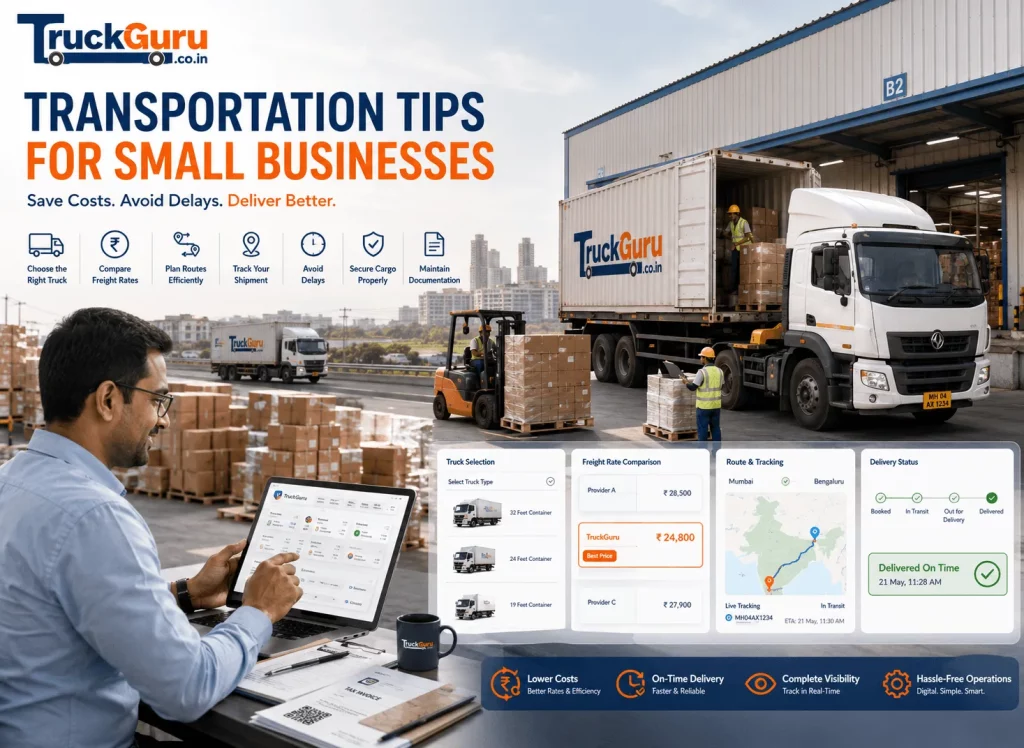
Incredibly Useful Transportation Tips For Small Businesses
Small businesses in India often pay more for freight than they need to. Not because freight is inherently expensive, but because informal booking habits — verbal quotes, broker dependency, last-minute bookings — create unnecessary cost and unpredictability.
Transportation Tips for Small Businesses: Quick Summary
Transportation tips for small businesses: Small businesses in India can cut freight costs and improve delivery reliability with the right transportation.
These tips are for B2B businesses: manufacturers, distributors, wholesalers, and traders who move commercial goods intercity by truck. Each one addresses a specific habit that either reduces cost, improves reliability, or protects you when something goes wrong.
1. Always Confirm the Rate Before the Truck Arrives
The most common freight cost problem for small businesses is a rate that changes between the phone call and the invoice. A broker quotes one number, the driver quotes another, and by the time the truck has loaded, arguing is difficult.
Book through a platform like TruckGuru where the rate is shown and confirmed before you pay anything. Use the freight calculator to see your per-km rate by truck type before committing.
2. Know Your Cargo Weight Before Calling
Truck booking rates are based on vehicle type, not weight alone — but the weight determines which vehicle you need. A shipment of 2T does not need a 5T truck. Booking an oversized vehicle wastes money. Booking an undersized one risks overloading or a refused pickup.
The truck size guide shows load capacity for each vehicle type. Know your cargo weight and volume before you book.
3. Book With Lead Time, Not at the Last Minute
Last-minute freight bookings cost more and give you less choice. On high-frequency corridors like Mumbai-Bangalore or Delhi-Hyderabad, trucks fill up quickly. Booking 2 to 3 days ahead on shorter corridors and 4 to 5 days ahead on longer corridors gives you better availability and more stable rates.
Last-minute bookings also push you toward informal broker calls, where rate certainty is lower and documentation is unlikely.
4. Understand What Toll Included Means
When comparing freight quotes, always check whether toll is included or listed separately. A quote of Rs.15,000 with toll extra can become Rs.17,500 or more by the time tolls are added for a 500 km corridor. On TruckGuru, toll is included in the fare confirmed at booking. No separate toll charges after delivery.
5. Get the LR (Lorry Receipt) at Loading
The Lorry Receipt is your proof that goods were handed over to the transporter. It records what was loaded, the vehicle details, the route, and the date. Without an LR, disputes about damage, shortage, or non-delivery have no paper to refer to.
On every TruckGuru booking, a digital LR is generated at loading. Keep it until delivery is confirmed and the final payment is cleared.
6. Have the E-Way Bill Ready Before the Truck Arrives
For goods valued above Rs. 50,000 crossing a state border, an e-way bill is mandatory under GST. The truck cannot legally move without it. If the e-way bill is not ready when the truck arrives, the driver waits — and waiting charges apply from the time of arrival.
Generate the e-way bill on the GST portal before the truck is dispatched. Have your GSTIN, invoice details, and transporter ID ready.
7. Track Your Shipment — Do Not Just Call the Driver
Calling the driver every few hours for an update is inefficient and gives you approximate information at best. GPS tracking through a booking platform gives you the live truck location and an estimated arrival time without a phone call.
For operations teams coordinating dock availability at the receiving end, GPS tracking allows real scheduling around an actual ETA rather than a guess.
8. Confirm Delivery Address Accessibility Before Dispatch
Large trucks — particularly 32ft containers — cannot access narrow lanes, low-clearance gates, or unmetalled approach roads. If the delivery address is in a congested area or an industrial estate with restricted access, confirm the truck size before booking.
A truck that cannot enter the delivery premises turns around and waiting charges apply. Confirming access takes one call before dispatch and saves significant cost and delay.
9. Pay Attention to Payment Terms
Standard TruckGuru payment terms are: Booking Amount at booking confirmation, 90% of the freight at loading before the truck departs, and the remaining balance before unloading at the destination.
Do not load goods before paying the 90% at loading. The LR is generated at this point. At delivery, pay the balance before unloading begins. This sequence protects both shipper and transporter and is the industry standard for FTL bookings.
10. Use Digital Invoices for Input Tax Credit
Every TruckGuru booking generates a GST-compliant invoice after delivery. The invoice carries the full tax breakup that your accounts team needs to claim input tax credit (ITC) on freight costs under GST.
If you are booking freight through informal broker arrangements, you are unlikely to receive a valid GST invoice — which means you lose the ITC on every freight booking. Over a year of regular shipments, this adds up.
FAQ
How can a small business reduce freight costs in India?
Book with lead time to get better rates and availability. Confirm the rate — including toll — before loading. Choose the right truck size for the cargo weight rather than defaulting to a larger vehicle. Use a digital booking platform for documented, confirmed pricing.
What is the best way to book a truck for a small business in India?
Use the TruckGuru freight calculator to check per-km rates by truck type before booking. Pay the Booking Amount to confirm. Receive driver details before dispatch. Track via GPS through the TruckGuru app.
What is a Lorry Receipt and why does it matter?
A Lorry Receipt (LR) is a document generated at loading that records the goods handed over, the vehicle details, the route, and the date. It is the shipper’s primary protection in disputes about damage, shortage, or non-delivery. Always get an LR at loading.
What are the payment terms for FTL truck bookings?
Booking Amount at booking confirmation, 90% of the freight at loading before the truck departs, and the remaining balance before unloading at the destination. Via UPI, NEFT, credit card, or debit card.
Is toll included in truck freight rates?
It depends on the transporter. On TruckGuru, toll is included in the confirmed per-km rate at booking. Always verify toll inclusion when comparing quotes — a lower headline rate with toll extra may end up more expensive.
What is an e-way bill and when is it required?
An e-way bill is a mandatory electronic permit under GST for goods worth more than Rs. 50,000 crossing a state border. It must be generated before the truck departs. Without it, the truck can be stopped at state checkposts and penalised.
How do I track a truck after booking?
GPS tracking is available through the TruckGuru app (Android and iOS) from dispatch to delivery on every booking. The driver’s direct contact number is also shared before pickup.
What truck size should a small business choose?
Choose by cargo weight: up to 1.5T use Tata Ace or Bada Dost, up to 3.5T use 14ft Eicher, up to 5T use 17ft Eicher, up to 7T use 19ft Eicher, bulk freight use 20ft or 32ft container. See the truck size guide for full specifications.
How far in advance should I book a truck?
2 to 3 days ahead for short corridors (under 500 km). 4 to 5 days ahead for longer routes (500 km to 2,000 km). Last-minute bookings cost more and give fewer vehicle choices.
How does TruckGuru help small businesses with freight?
TruckGuru provides confirmed rates before booking (not verbal quotes), digital LR at loading, GST invoice after delivery, GPS tracking, and verified drivers. FTL intercity only — no PTL, no local city delivery, no household shifting.
Check your freight rate at the TruckGuru freight calculator or call +91-7202045678. Support hours: Mon-Sat 9:30 AM to 6:30 PM, Sun 9:30 AM to 2:30 PM.
Related Reading
- How to Estimate Goods Transport Rates: A Beginner’s Guide
- How Are Truck Transportation Charges Calculated in India?
- 6 Truck Booking Platforms Compared for FTL Freight in India: FR8, WheelsEye, Trukky, BlackBuck, Vahak & TruckGuru
For current rules and official notifications, see the Ministry of Road Transport & Highways.