

Why You Should Use a Transportation Company’s Services
India moves roughly 70% of its freight by road. For most businesses, the truck that carries their goods is booked over a phone call to a broker who quotes a number that changes by the time the vehicle arrives. That gap between quoted and actual cost is the single biggest reason businesses switch to a transportation company.
Transportation Company for Business: Quick Summary
Transportation Company for Business: Businesses using a transportation company get confirmed rates, GST documentation, and GPS tracking that broker-based.
This article covers what changes when a business moves from broker-based freight sourcing to a transportation company, and how to evaluate whether the switch makes sense for your operation.
What Does a Transportation Company Actually Do?
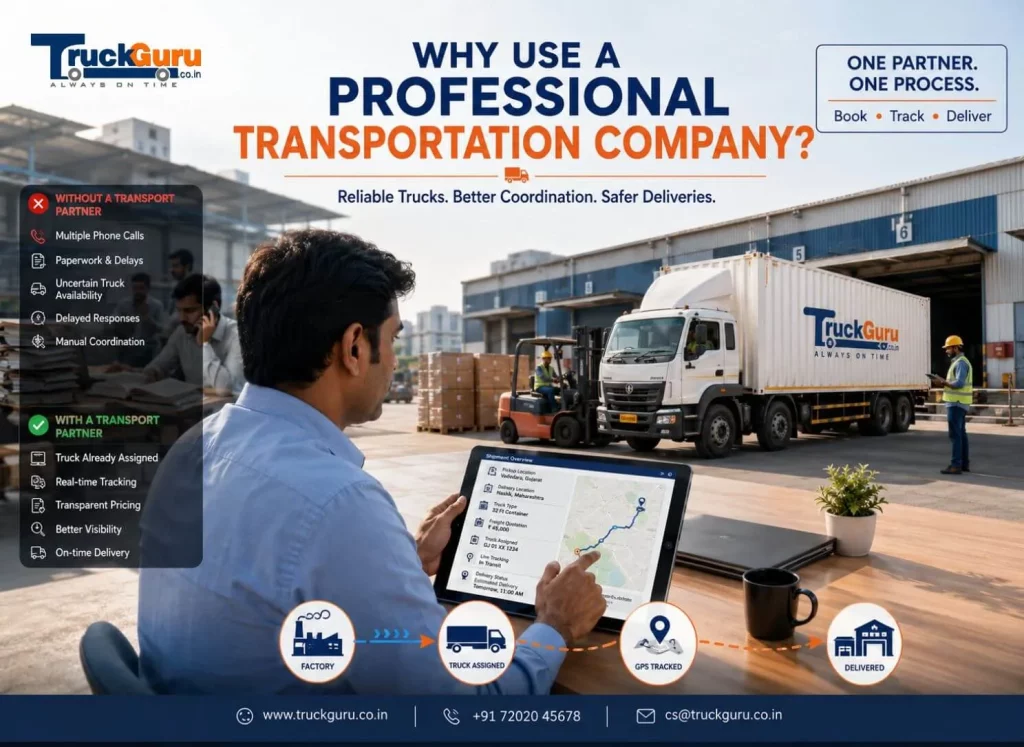
A transportation company handles the booking, dispatch, documentation, and tracking of freight movements between locations. Unlike a broker who connects a shipper to a truck owner and takes a margin, a transportation company operates the process end to end: confirmed pricing, verified vehicles, digital paperwork, and tracking from dispatch to delivery.
In India, the practical distinction shows up in four places:
- Rate certainty: A transportation company quotes a rate that is confirmed before dispatch. A broker quotes verbally and the number can shift at loading.
- Vehicle verification: Trucks are checked for RC, fitness certificate, and driver documentation before being assigned. Broker-sourced vehicles are typically not verified.
- Documentation: LR at dispatch, GST invoice after delivery, e-way bill support. Broker arrangements often have no paper trail.
- Tracking: GPS location visible to the shipper. Broker arrangements require calling the driver for updates.
Why Do Businesses Switch from Brokers to Transportation Companies?
The switch usually happens after a specific incident: a rate that changed at loading, a consignment that arrived damaged with no documentation to support a claim, or a delivery that missed a production window with no way to know the truck was delayed.
For businesses moving freight regularly, the cumulative cost of these incidents outweighs any per-trip saving from broker rates. A manufacturer running weekly dispatches from Pune to Chennai on a fixed schedule needs the delivery to land inside a window. A pharma distributor shipping from Ahmedabad to Hyderabad needs documented handover for compliance. Neither is served well by a verbal arrangement.
What Are the Main Benefits of Using a Transportation Company?
Confirmed pricing before dispatch
The freight rate is shown and locked before the truck is assigned. On TruckGuru, the rate visible on the freight calculator at booking is the rate that appears on the invoice after delivery. Toll is included. No fuel surcharge is added at pickup.
Verified trucks and drivers
Every vehicle goes through document and registration checks before being listed. For auto component suppliers running plant-to-plant dispatches where the receiving assembly line does not wait, an unverified operator is not an acceptable risk.
GST-compliant documentation
Every booking generates an LR (Lorry Receipt) at dispatch and a GST invoice after delivery with the full tax breakup. That invoice is what your accounts team needs to claim input tax credit on freight costs. Broker arrangements rarely produce a compliant invoice.
E-way bill support
For consignments above Rs. 50,000 crossing state borders, an e-way bill is mandatory under GST. A transportation company builds this into the booking flow rather than leaving it as a separate compliance step for the shipper to remember.
Live GPS tracking
Once dispatched, the truck location is visible through the platform. For an operations team coordinating a receiving dock in Bangalore for a consignment leaving Mumbai, live location means scheduling around an actual ETA rather than a guess.
How Much Does a Transportation Company Cost in India?
On TruckGuru you pay a trip fare by truck type, toll included. Rates are not fixed; they move with route, cargo, date and availability. Two examples:
| Route | Truck | Indicative trip fare |
| Mumbai to Ahmedabad (about 530 km) | 14ft Eicher (3.5T) | Rs.16,400 – Rs.18,600 |
| Delhi to Bangalore (about 2,150 km) | 32ft Container (16T) | Rs.1,67,700 – Rs.1,82,800 |
Indicative fares, checked October 2026. Freight rates move with route, vehicle type, cargo, date and availability. Confirm the current rate at booking.
Check a rate for a specific corridor on the TruckGuru freight calculator.
When Should a Business Use a Transportation Company Instead of Its Own Fleet?
Owning trucks makes financial sense when a business runs consistently high freight volume on fixed routes with predictable return loads. Below that threshold, the cost of ownership — vehicle purchase, driver salaries, maintenance, insurance, permits, and idle time between trips — exceeds the per-trip cost of booking.
The practical break-even in Indian B2B logistics sits around 15 to 20 dispatches per month on the same corridor with a reliable return load. Below that, booking through a transportation company is more cost-efficient. Most SMEs and mid-size manufacturers fall below that threshold.
What Should You Check Before Choosing a Transportation Company?
- Is the rate confirmed before dispatch, or quoted after loading?
- Is toll included in the quoted rate, or billed separately afterwards?
- Does every booking generate a GST-compliant invoice?
- Are trucks verified for RC, fitness, and driver documentation?
- Is GPS tracking available from dispatch, or only status updates on request?
- Is the service FTL (dedicated truck) or PTL (shared load)?
- What are the payment terms and when is the balance due?
On TruckGuru: rate confirmed at booking with toll included, GST invoice after every delivery, verified trucks, GPS tracking from dispatch, FTL only, and payment split as Booking Amount at confirmation, 90% at loading, balance before unloading.
Key Takeaways
- A transportation company handles booking, dispatch, documentation, and tracking end-to-end — a broker only connects shipper to truck owner
- Rate certainty before dispatch is the primary reason businesses switch from broker-based freight
- GST-compliant invoicing enables input tax credit claims that broker arrangements typically cannot support
- E-way bill compliance is mandatory above Rs. 50,000 for interstate consignments
- Own-fleet economics generally require 15 to 20 monthly dispatches on a fixed corridor to break even
- TruckGuru quotes a trip fare with toll included; rates are not fixed and move with route, cargo and date
FAQ
What is a transportation company?
A transportation company handles the booking, dispatch, documentation, and tracking of freight between locations. It differs from a broker by operating the full process rather than only connecting a shipper to a truck owner.
Why should a business use a transportation company instead of a broker?
Confirmed rates before dispatch, verified vehicles, GST-compliant invoicing for input tax credit, e-way bill support, and GPS tracking. Broker arrangements typically offer none of these consistently.
How much does freight transport cost in India?
It depends on the truck and the route. On a route of about 500 km, a mini truck (Tata Ace, Bada Dost) is indicatively Rs.13,000 – Rs.14,500, a 14ft Eicher Rs.15,500 – Rs.17,500 and a 32ft 16-ton container Rs.39,000 – Rs.42,500, toll included. Indicative fares, checked October 2026. Freight rates move with route, vehicle type, cargo, date and availability. Confirm the current rate at booking. Book – Rates For per-km ranges, see the rate card by truck type.
Is toll included in transportation company rates?
It varies by provider. On TruckGuru, toll is included in the trip fare confirmed at booking. Always verify toll inclusion when comparing quotes — a lower headline rate with toll billed separately can cost more overall.
What documents does a transportation company provide?
An LR (Lorry Receipt) generated at dispatch, a GST-compliant invoice after delivery, and e-way bill support for consignments above Rs. 50,000 crossing state borders.
What is the difference between FTL and PTL?
FTL (Full Truck Load) means one dedicated truck carries one shipper’s consignment with no co-loading. PTL (Part Truck Load) means the cargo shares space with other shippers. TruckGuru books FTL only.
Can I track my consignment with a transportation company?
On platforms offering GPS tracking, yes. TruckGuru provides live GPS tracking through its Android and iOS app from dispatch to delivery, with the driver’s direct number shared at booking confirmation.
Does a transportation company handle household shifting?
Depends on the provider. TruckGuru handles commercial and industrial goods only — household relocation, packers and movers, and vehicle transport are not offered.
For FTL freight across 110+ Indian cities, check your rate on the TruckGuru freight calculator or call +91-7202045678.
Related Reading
- How to Estimate Goods Transport Rates: A Beginner’s Guide
- How Are Truck Transportation Charges Calculated in India?
- 6 Truck Booking Platforms Compared for FTL Freight in India: FR8, WheelsEye, Trukky, BlackBuck, Vahak & TruckGuru
For current rules and official notifications, see the Ministry of Road Transport & Highways.