

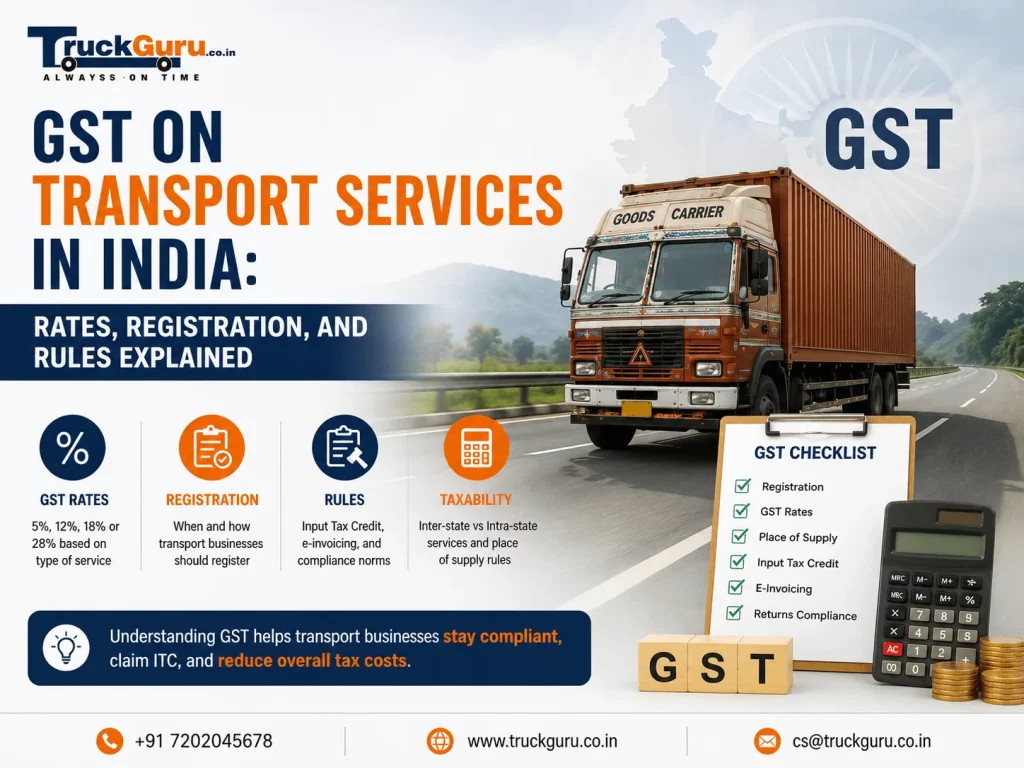
GST on Transport Services in India: Rates, Registration, and Rules Explained
A manufacturer in Pune booking a truck to Hyderabad and a courier company moving parcels across the city both pay GST on transport — but at different rates, under different rules, for different reasons. Mixing the two up is where most of the confusion around “GST on transport” actually comes from.
This guide sticks to goods transport — the GST that applies when a business moves freight by road. Passenger transport runs on its own separate rate structure (metered autos and regular buses sit at 0%, AC buses and app-based cabs at 5%) and isn’t the subject here. What follows covers tax rates for goods transport agencies, registration rules, the reverse charge mechanism, exemptions, and one distinction that trips up more businesses than anything else on this list: the difference between renting a vehicle and booking a transport service.
What Counts as a Goods Transport Agency
A Goods Transport Agency, or GTA, is any person or company that provides road transport for goods and issues a consignment note for that shipment. The definition comes from the explanation clause attached to Notification No. 11/2017-Central Tax (Rate) and Notification No. 12/2017-Central Tax (Rate), both dated 28 June 2017 — not from a numbered section of the CGST Act itself, which is a distinction worth getting right since plenty of guides cite this incorrectly.
The consignment note is what separates a GTA from someone simply renting out a truck. Issue one: You’re providing a transport service taxed under the GTA rules below. Don’t issue one — if you’re just handing over a vehicle for the customer to use — and you’re in rental territory, taxed differently. More on that distinction shortly, because it matters more than most guides give it credit for.
Manufacturers shipping finished goods, e-commerce companies moving inventory between warehouses, and B2B traders sending consignments to dealers are the businesses that interact with the GTA rules most often. If your business books trucks regularly, this is the part of GST you’ll deal with on every invoice.
GST Rates for Goods Transport Agencies
A GTA has two rate options, and the choice changes who pays and what can be claimed back.
- 5% GST without Input Tax Credit (ITC): the GTA charges no ITC-eligible GST. Under the Reverse Charge Mechanism, the customer receiving the service pays the 5% directly to the government, not the GTA.
- 12% GST with ITC: the GTA charges 12% itself and can claim input tax credit on fuel, vehicle maintenance, and other business costs. This works better for GTAs with high input expenses.
Most GTAs — TruckGuru included — operate at 5% under RCM. It keeps the GTA’s compliance simpler, and for GST-registered business customers, that 5% comes back as ITC in most cases, which means the effective cost is often lower than the sticker rate suggests.
GST on Vehicle Rental: Why It’s Not the Same as a GTA Service
Here’s where a lot of businesses get their math wrong. Renting a truck or tempo — where you take the vehicle and operate it yourself, with no consignment note and no GTA responsible for the goods in transit — is taxed at 18% GST under a completely different service category (SAC 9966). That’s a vehicle rental, not a GTA service, and the 18% rate has nothing to do with the 5%/12% GTA rates above.
The test is simple: did the transporter issue a consignment note and take responsibility for moving your goods from A to B? If yes, you’re booking a GTA service at 5% or 12%. If you’re just borrowing a vehicle and driving it yourself, you’re renting at 18%. Businesses that assume “trucks are 18% GST” because they once rented a vehicle end up overestimating freight costs when they later book an actual GTA service — the rate is less than half.
For businesses, the 18% on vehicle rental can be claimed back as ITC if the vehicle is used for business purposes. Individuals renting for personal reasons pay the 18% with no ITC recovery.
Does a GTA Need GST Registration?
Not always, and this confuses smaller transporters more than anything else in this guide.
Under Notification No. 5/2017-Central Tax dated 19 June 2017, any person whose supplies are exclusively covered under the Reverse Charge Mechanism is exempt from mandatory GST registration — regardless of how much they earn. Since a GTA operating purely at 5% under RCM falls into exactly this category, a transporter who only does RCM business can legally skip registration entirely.
In practice, most transporters register anyway. Bigger clients — the manufacturers and distributors who make up most of the freight market — prefer working with registered GTAs because it signals a level of compliance and professionalism that unregistered operators can’t match, even when the law doesn’t strictly require it.
Documents Needed for GTA Registration
If you’re registering as a GTA, the paperwork is the same as standard GST registration — nothing transport-specific is required:
- Aadhaar card
- PAN card
- Bank account details
- Proof of business address — electricity bill or rent agreement
- Property papers, if the business owns the premises
- A permission letter from the owner, if the premises is rented
Having these ready before starting the application avoids the back-and-forth that slows most registrations down.
How the Reverse Charge Mechanism Actually Works
RCM flips who pays GST to the government. Normally, a service provider collects GST from the customer and deposits it. Under RCM, the customer deposits it directly — the GTA never touches that money.
Take a manufacturer paying Rs. 50,000 in freight charges for a shipment. Under the 5% RCM structure, the manufacturer pays GST of Rs. 2,500 directly to the government, separate from the Rs. 50,000 paid to the transporter. If the manufacturer is GST-registered and uses the goods for business, that Rs. 2,500 comes back as input tax credit — so the real cost of the freight ends up being just the Rs. 50,000, not Rs. 52,500.
This is why RCM works well for smaller transporters: no GST collection, no GST deposit, no extra compliance burden on their side. The customer — usually a larger, GST-registered business better equipped to handle the paperwork — carries that responsibility instead.
When Goods Transport Is Exempt from GST
Certain categories of freight carry no GST at all, regardless of which rate structure the GTA normally uses:
- Agricultural produce — vegetables, fruits, and similar farm goods
- Milk and dairy products
- Food grains, including wheat, rice, and pulses
- Newspapers and magazines
- Any shipment where the freight charge for a single consignment doesn’t exceed Rs. 1,500
- All goods transported for one consignee in a single trip, where the total charge is Rs. 750 or less
The last two exemptions exist for small, low-value shipments — they keep tiny local deliveries from getting bogged down in GST paperwork that costs more to process than the tax itself would raise.
Input Tax Credit Rules for GTA Customers
Whether a business can claim back the GST it pays on freight depends on which rate structure applies:
- Pay 12% GST charged directly by the GTA: claimable as ITC, same as any other business input
- Pay 5% under RCM: not claimable by the GTA, but the customer can usually claim it as ITC on their own return
- Only registered businesses can claim ITC — individuals using transport for personal reasons cannot
- The freight must relate to business activity — goods moved for personal use don’t qualify even if the payer is GST-registered
What This Means for Businesses Booking Freight Regularly
Get the GST treatment right, and freight costs become predictable. Get it wrong — assuming every truck booking is 18% because of a past rental, or missing ITC eligibility on RCM payments — and freight either looks more expensive than it is or you leave recoverable money sitting unclaimed.
Manufacturers, distributors, and online sellers who book FTL transport regularly should confirm with their transporter which rate structure applies before the invoice arrives, not after. A registered GTA operating at 5% RCM, issuing a proper consignment note and GST-compliant invoice, gives a business everything needed to claim that ITC cleanly.
How TruckGuru Handles GST on Every Booking
TruckGuru operates as a registered Goods Transport Agency on its FTL intercity network, charging 5% GST under the Reverse Charge Mechanism on every booking. Each trip generates a GST-compliant invoice with the correct SAC code (9965) for transport services, along with a digital Lorry Receipt at dispatch that serves as your consignment note.
For a confirmed freight rate that already accounts for GST treatment: freight calculator.
For how GST changed logistics operations more broadly — check posts, e-way bills, and transit times — see the companion piece: impact of GST on the logistics industry.
Frequently Asked Questions
What is the GST rate for goods transport agencies in India?
5% GST without Input Tax Credit under the Reverse Charge Mechanism, where the customer pays the GST directly. Or 12% GST with ITC, where the GTA charges and collects the GST itself and can claim credit on its inputs.
Is GST on truck rental the same as GST on a GTA service?
No. Renting a vehicle without a consignment note — where you operate the vehicle yourself — is taxed at 18% under a separate vehicle rental category (SAC 9966). A GTA service, where the transporter issues a consignment note and takes responsibility for your goods, is taxed at 5% or 12% instead.
Does a transporter need to register for GST?
Not always. A GTA whose business is entirely RCM-based is exempt from mandatory registration under Notification No. 5/2017-Central Tax, regardless of turnover. Most transporters register anyway because larger B2B clients prefer working with registered, GST-compliant operators.
What goods are exempt from GST on transport?
Agricultural produce, milk and dairy, food grains (wheat, rice, pulses), and newspapers carry no GST on transport. Shipments under Rs. 1,500 per consignment, or under Rs. 750 total for a single consignee, are also exempt.
Can a business claim back GST paid on freight under RCM?
Yes, in most cases. A GST-registered business paying 5% GST under RCM on freight used for business purposes can claim that amount as input tax credit on its own GST return.
The Short Version
Goods transport by a registered GTA runs at 5% (RCM, customer pays) or 12% (GTA charges directly, can claim ITC) — not 18%. That 18% rate is for renting a vehicle outright, not booking a transport service. Small shipments under Rs. 1,500 (or Rs. 750 for a single consignee) are GST-exempt, and registered businesses can usually claim back what they pay under RCM. Get this right once, and every freight invoice afterwards makes sense at a glance.
Call 72020 45678 or book online at truckguru.co.in. Every booking includes a GST-compliant invoice with the correct SAC code and a digital consignment note at dispatch.