

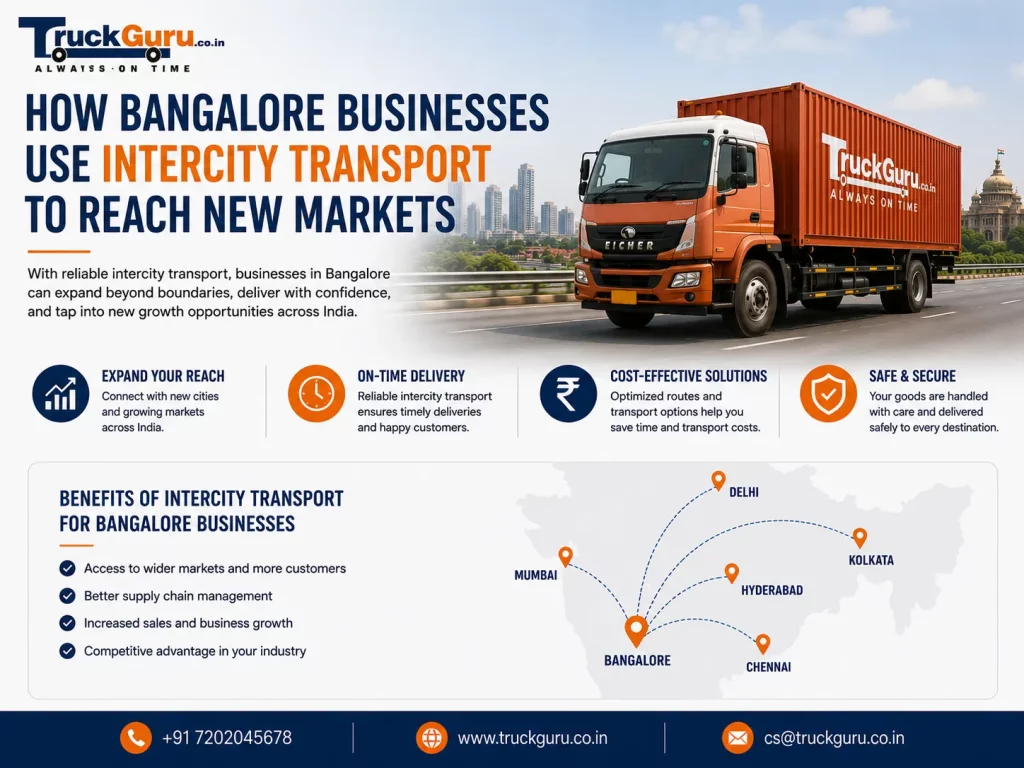
How Bangalore Businesses Use Intercity Transport to Reach New Markets
A Bangalore manufacturer selling only within Karnataka is leaving most of the country’s demand untouched. The usual blocker is not product-market fit — it is the assumption that entering a new city means setting up local distribution there first: a warehouse, a sales office, a standing relationship with a local logistics provider. Intercity FTL transport removes that requirement. A business can test a new market by shipping directly to buyers there, with no local infrastructure investment until the demand actually justifies it.
Local Transport in Bangalore: Quick Summary
Need local transport in Bangalore? Discover how efficient intra city logistics can boost Indian businesses with fast deliveries and reduced operational costs.
This is a more useful way to think about “transport connectivity” than the vague version most guides offer. It is not about transport in the abstract — it is about whether your specific corridor to a specific city is reliable enough to build a sales relationship on.
Testing a Market Before Committing to It
The lowest-risk way to enter a new city is to ship a handful of trial orders by FTL before signing a distributor agreement or leasing warehouse space there. A Peenya-based engineering goods manufacturer curious about Hyderabad demand can fulfil the first few orders from a Bangalore dispatch on an 8-9 hour corridor, see how buyers respond, and only then decide whether local stocking in Hyderabad makes sense.
This works because FTL booking has no long-term commitment attached to it — you are not locking into a distribution contract to find out if a market is worth pursuing. The cost of testing is just the freight for those trial shipments, not a fixed monthly overhead you carry regardless of how the test goes.
What Actually Makes a Corridor Viable for Expansion
Three things matter more than raw distance once a business moves from testing to relying on a corridor regularly:
- Transit time consistency — a route quoted at 8-9 hours that reliably lands in that window lets you make delivery promises to a new buyer with confidence; a route with wide, unpredictable variance does not
- Shipment frequency the corridor can support — a corridor you will use once a month has very different planning needs than one you will use several times a week
- Unit cost at the volume you expect — per-trip FTL rates that work fine for occasional shipments may justify dedicated capacity once volume on that corridor grows consistently
Where This Plays Out for Bangalore Businesses Specifically
Bangalore’s manufacturing base is concentrated in engineering goods, electronics, and auto components — cargo categories with B2B buyers spread across most major Indian industrial cities, which makes geographic expansion a genuine question for businesses based in Peenya, Electronic City, Bidadi, and Jigani.
- Bangalore to Chennai (~346 km, 5-6 hrs) — same-day corridor, suited to testing Tamil Nadu demand without overnight transit risk
- Bangalore to Coimbatore (~365 km, 5-6 hrs) — same-day corridor into the western Tamil Nadu engineering and textile machinery belt
- Bangalore to Hyderabad (~570 km, 8-9 hrs) — a reasonable single-day dispatch for testing Telangana and broader Deccan demand
- Bangalore to Mumbai (~840-980 km, 14-16 hrs) — a longer corridor better suited to planned, recurring shipments than ad hoc trial orders
Compliance Does Not Get Harder as You Expand — It Gets More Routine
Every interstate shipment above Rs. 50,000 needs an e-way bill, regardless of whether it is your first shipment to a new city or your fiftieth. The paperwork does not scale up with market expansion — it stays the same per shipment. What changes is that a business shipping regularly into three or four states gets faster at the documentation simply through repetition, not because the requirement itself changes.
Knowing When to Move Beyond Testing
FTL transport is the right tool for the testing phase, not necessarily forever. A corridor that starts as occasional trial shipments sometimes grows into something that justifies local stocking or a dedicated distribution arrangement in the destination city — the signal to watch for is shipment frequency climbing to a point where a local warehouse would cut down on per-unit freight cost more than it would cost to run. Until that point is genuinely reached, continuing to ship by FTL keeps the business from committing capital to infrastructure that a market has not yet proven it needs.
This is also where the corridor frequency point from earlier becomes a practical decision rule rather than an abstract consideration: a business shipping to Hyderabad twice a month is still squarely in testing territory; one shipping there twice a week has probably outgrown ad hoc FTL bookings and should be looking at what a standing local arrangement would cost by comparison.
How TruckGuru Fits Into Testing a New Market
A confirmed rate at booking means the unit economics of a trial shipment are known before you commit to it — no surprise costs that change the math after the fact. There is no minimum volume commitment to access a corridor; the rate for one trip is the same predictable structure as the rate for the fiftieth trip on that route.
Check rates for a corridor you are considering on the freight calculator. For more on how Bangalore intercity bookings work day to day, see Truck Rental in Bangalore: How FTL Booking Actually Works.
Frequently Asked Questions
How can a Bangalore business test demand in a new city without local infrastructure?
Ship a handful of trial orders directly by FTL transport before committing to a distributor agreement or warehouse lease in the new city. This limits the cost of testing to the freight itself, rather than a fixed overhead you carry regardless of outcome.
What makes an intercity transport corridor reliable enough to build a business on?
Consistency matters more than speed — a route that reliably completes within its quoted transit window lets you make delivery commitments to buyers with confidence. The frequency the corridor can realistically support and the unit cost at your expected volume matter as much as the distance itself.
Does expanding to multiple states make e-way bill compliance harder?
Not really. Each interstate shipment above Rs. 50,000 needs an e-way bill regardless of how many states you ship to in total. The requirement is per shipment, not cumulative, so expansion does not multiply the compliance burden — it just means doing the same per-shipment process more often.
What Bangalore corridors work well for testing a new market quickly?
Chennai and Coimbatore, both 5-6 hour same-day corridors, are lower-risk for trial shipments since transit completes within a single day. Hyderabad at 8-9 hours is still manageable for a single-day dispatch. Mumbai’s longer transit time suits planned, recurring shipments better than ad hoc trial orders.
Call 72020 45678 or check rates at truckguru.co.in/freight-calculator before testing your next corridor.
Related Reading
- Reduce Manufacturing Freight Costs: India Intercity Guide
- Reduce B2B Freight Costs in India: 25 Proven Strategies
- Ship-To GSTIN Mandate August 2026 — What Shippers Must Do
For current rules and official notifications, see the Ministry of Road Transport & Highways.