

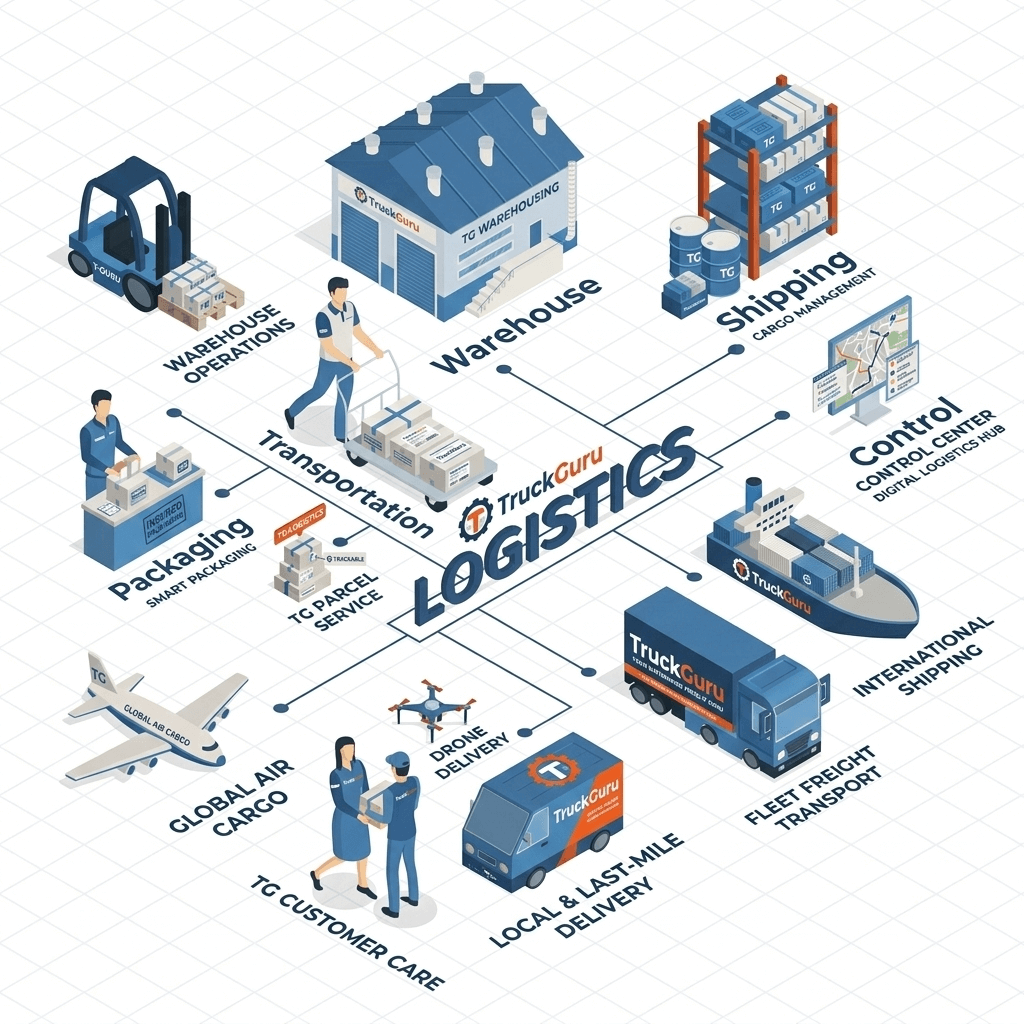
What is a Logistics Company? Types, Services and How They Work in India
A textile manufacturer in Surat produces 8 tonnes of fabric that needs to reach a distributor in Delhi within 3 days. A pharmaceutical company in Ahmedabad runs weekly dispatches of formulations to hospital networks across Rajasthan and Madhya Pradesh. A steel fabricator in Dankuni, Kolkata, sends monthly consignments of structural components to construction sites in Hyderabad.
All three operations depend on logistics companies. Not couriers, not parcel services — logistics companies that move commercial freight between businesses across intercity and interstate distances. The term logistics gets used loosely, but for B2B freight buyers, it has a specific meaning worth understanding before choosing a transport company.
What is a Logistics Company
A logistics company plans, organises, and executes the movement of goods from origin to destination. In the B2B context, this typically means moving commercial quantities of goods – raw materials, finished products, industrial components – from a manufacturer, warehouse, or supplier to a buyer, distributor, or end user in another city or state.
The term covers a wide range of business models. A company that owns trucks and moves goods directly is a logistics company. A company that coordinates multiple trucking operators to cover a pan-India network is also a logistics company. A company that manages warehousing, inventory, and distribution for a brand is also a logistics company. These are different businesses with different cost structures, but the same label applies to all of them.
For a B2B shipper choosing a transport company in India, the distinction that matters most is not the label – it is understanding exactly which part of the supply chain a specific company handles and how well.
What Logistics Companies Do
The core activity is moving goods. Everything else — warehousing, documentation, tracking, customs clearance — exists to support that movement. The main activities:
Transportation
Moving goods from pickup to delivery using trucks, trains, ships, or air freight. In India, road freight via truck handles approximately 70% of total goods movement by volume, making trucking the backbone of domestic B2B goods transport. Most intercity B2B shipments use either full truckload (FTL) truck booking or LTL (shared truck) arrangements.
Warehousing and Storage
Holding goods at a facility between production and distribution. Relevant for businesses with seasonal production cycles, distributors receiving bulk consignments and dispatching in smaller quantities to retailers, or businesses building stock before a product launch.
Inventory Management
Tracking stock levels, managing reorder points, and providing visibility into what is in storage and where. Typically part of a 3PL or 4PL service package rather than a standalone offering.
Documentation and Compliance
Generating and managing the paperwork that moves with goods — LR (Lorry Receipt), e-way bills, GST invoices, customs documents. For interstate road freight in India, an e-way bill is mandatory for consignments above Rs. 50,000 in value. See the full guide: e-way bill for freight transport.
Reverse Logistics
Managing the return flow of goods — products returned by customers, rejected consignments, end-of-life goods for recycling or disposal. More relevant for e-commerce and consumer goods than for B2B industrial freight.
Types of Logistics Companies — 1PL to 5PL
The 1PL to 5PL classification is a useful framework for understanding how logistics responsibility is structured. In practice, most B2B shippers in India work with 2PL or 3PL providers.
1PL — First-Party Logistics
The business handles its own logistics — owns trucks, manages drivers, runs warehouses. Example: a steel plant that operates its own fleet for raw material movement. High control, high capital cost, no flexibility to scale down.
2PL — Second-Party Logistics
A transport company that provides vehicles and drivers. The shipper manages the truck booking. Example: a trucking company moving goods for manufacturers and distributors. This is the simplest external logistics arrangement — you buy truck hire capacity and manage the process yourself. Most online truck booking platforms like TruckGuru operate on this model.
3PL — Third-Party Logistics
An external provider that manages transportation, warehousing, and distribution on behalf of the shipper. Example: a cargo transportation company handling FMCG distribution for a consumer goods brand. The shipper outsources execution; the 3PL manages multiple carriers and facilities. Most large FMCG and pharma companies in India use 3PL providers for their distribution networks.
4PL — Fourth-Party Logistics
A company that manages multiple logistics providers and the entire supply chain on behalf of the client. The 4PL does not own assets — it manages the 3PLs, trucking operators, and warehouses that do. Example: a logistics management firm coordinating trucking, warehousing, and customs for a large multinational manufacturer.
5PL — Fifth-Party Logistics
Technology-driven logistics networks that manage complex, multi-modal supply chains using automation and data. Relevant for large-scale operations with sophisticated supply chain requirements.
For most B2B shippers in India — manufacturers, traders, distributors — the practical choice is between 2PL (book a truck directly) and 3PL (outsource the whole distribution function). The right choice depends on shipment frequency, cargo complexity, and internal capacity to manage logistics coordination.
B2B Freight Logistics in India
India moves approximately 2,500 million tonnes of freight annually by road. The trucking sector is fragmented — around 75% of truck operators own 5 or fewer vehicles. This fragmentation means most shippers have historically sourced trucks through brokers, with verbal truck rates that change between booking and invoice and inconsistent documentation. Lorry booking through brokers remains common, but digital freight platforms now connect shippers directly with verified truck operators at confirmed rates. For a step-by-step breakdown of how the online truck booking process works, see: how to book a truck online in India.
The distinction from courier services like Blue Dart or DTDC matters: those handle parcels and small shipments, often consolidating multiple consignments in one vehicle. A logistics company handling B2B freight uses dedicated trucks — the entire vehicle is booked for one shipper’s goods transport, travelling from pickup to delivery without co-loading. This is an FTL truck booking, not a courier or parcel service.
FTL vs LTL — Which Freight Model Fits Your Business
FTL — Full Truck Load
The entire truck is booked exclusively for one shipper’s consignment. Goods travel directly from pickup to delivery with no intermediate stops. The right model is when the consignment is large enough to justify a dedicated vehicle, when truck transport rates make FTL economical, or when cargo sensitivity requires no co-loading. Full comparison: FTL vs LTL freight in India.
- Truck use: entire truck for one shipper only
- Transit time: direct, no intermediate stops
- Rate basis: per trip (full truck, regardless of whether full)
- Documentation: single LR for the consignment, simpler tracking
- Best for: large volumes, time-sensitive cargo, sensitive or high-value goods
LTL or PTL — Less Than Truck Load / Part Truck Load
Multiple shippers share space in one truck. Each shipper pays for the space their consignment occupies. More economical for smaller consignments but involves longer transit times due to multiple stops.
- Truck use: shared with other consignments
- Transit time: longer due to multiple stops
- Rate basis: per kg or per unit of volume
- Documentation: multiple LRs, more complex tracking
- Best for: small volumes where FTL truck transport rates do not work economically
How to Choose a Logistics Company in India
The right transport company depends on what you are moving, how often, and what the consequences of a service failure look like. Questions that sharpen the decision:
- Does the company actually operate on your specific corridor? Coverage claims are easy to make — ask for specific routes with transit time data
- Is the rate confirmed before the truck is dispatched, or verbal and subject to revision at delivery?
- What documentation does every booking generate? LR, GST invoice, and e-way bill support should be standard, not optional
- Is GPS tracking live and accessible, or is tracking done by calling the driver?
- What happens when something goes wrong? Who is the point of contact, and what is the escalation process?
Truck Rates and How Freight Pricing Works in India
Truck transport rates in India are calculated on a per-trip basis for FTL: base price plus per-km rate depending on the truck type. A Tata Ace (750 kg) runs at a lower per-km rate than a 32ft container (15 tonnes). Rates vary with diesel prices, corridor demand, and seasonal factors. For transparent truck rates before booking, use the freight calculator – it shows the confirmed rate on your specific route before you commit. For a full breakdown of how truck transport rates are calculated in India, see: truck freight rates India guide.
Most transporters near me search in India return local operators with informal pricing. The difference with a digital freight platform is that the rate is confirmed before dispatch – not negotiated after the truck arrives at your gate.
Where TruckGuru Fits in the Logistics Landscape
TruckGuru is an FTL intercity truck booking platform for B2B shippers. It is not a 3PL provider — it does not manage warehousing, inventory, or distribution. It is a 2PL platform that connects shippers directly with verified truck operators across 110+ cities in India, with confirmed truck rates before dispatch, GPS tracking on every booking, and digital documentation (LR, GST invoice, e-way bill support) generated automatically.
The fleet covers Tata Ace (750 kg) through a 32ft container (15 tonnes). Every truck is document-verified before listing. The rate confirmed at online truck booking is the rate on the invoice. The truck booking app provides live GPS tracking from dispatch through delivery. This is the specific segment of the logistics market TruckGuru serves — intercity FTL goods transport for manufacturers, distributors, traders, and industrial buyers moving commercial freight between cities regularly.
For businesses needing warehousing, distribution management, or courier services, those are different logistics categories served by different providers.
For intercity FTL goods transport across India, use the transportation cost calculator for a live rate on your specific route, or call 72020 45678.
FAQs — What is a Logistics Company
What is the difference between a logistics company and a courier company?
Courier companies handle small parcels — typically under 30 kg — consolidating multiple shipments in one vehicle. Logistics companies in the freight sense handle commercial quantities of goods — pallets, full truck loads, bulk cargo. The two categories serve different needs and operate on different truck rates, documentation models, and service levels.
What is 3PL in logistics?
3PL (Third-Party Logistics) refers to outsourcing transportation, warehousing, and distribution to an external provider. A 3PL manages the physical movement and storage of goods on behalf of a business. Large FMCG and e-commerce companies typically use 3PL providers — smaller B2B shippers usually find that direct truck booking through a 2PL platform is more cost-effective and simpler to manage.
What is FTL in truck booking?
FTL (Full Truck Load) means booking an entire truck exclusively for one consignment – no co-loading. The goods travel directly from pickup to delivery. This contrasts with LTL or PTL, where multiple shippers share space in one truck. For the full comparison, see: FTL vs LTL freight in India.
How does road freight logistics work in India?
India moves approximately 70% of its freight by road. Most intercity goods transport is booked through truck operators – directly, through brokers, or through online truck booking platforms. An LR (Lorry Receipt) is generated at dispatch and travels with the goods. E-way bills are mandatory for interstate consignments above Rs. 50,000. GST on freight services runs at 5% for GTA services or 12%, depending on the arrangement. See: e-way bill freight guide.
What documents are required for B2B freight in India?
For intercity commercial goods transport: LR (Lorry Receipt) at dispatch, e-way bill for consignments above Rs. 50,000 crossing state borders, GST invoice from the transporter, and a delivery receipt at drop-off. For pharmaceuticals, chemicals, and food products, additional permits may be required depending on the cargo type and states crossed.
Is TruckGuru a 3PL company?
No. TruckGuru is a 2PL platform — it provides truck hire and transportation services directly without managing warehousing or distribution. It connects B2B shippers with verified truck operators for FTL intercity bookings across India. Businesses needing full 3PL services need a different category of provider. To book a truck or check truck transport rates: truck booking online.
How do I find transporters near me in India?
Most “transporters near me” searches return local brokers with informal pricing. For intercity FTL goods transport with confirmed rates, verified trucks, and digital documentation, use the online truck booking platform or check truck rates on the transportation cost calculator before calling any transporter.
To book a truck or check truck transport rates for intercity FTL freight across India, use the transportation cost calculator, or call 72020 45678.
Related Reading
- Common Questions FTL Shippers Ask Before Booking a Truck
- Why Are Small Trucks the Best Choice for Last-Mile Delivery?
- Major Indian Transport Challenges and How Shippers Can Win
For current rules and official notifications, see the Ministry of Road Transport & Highways.