

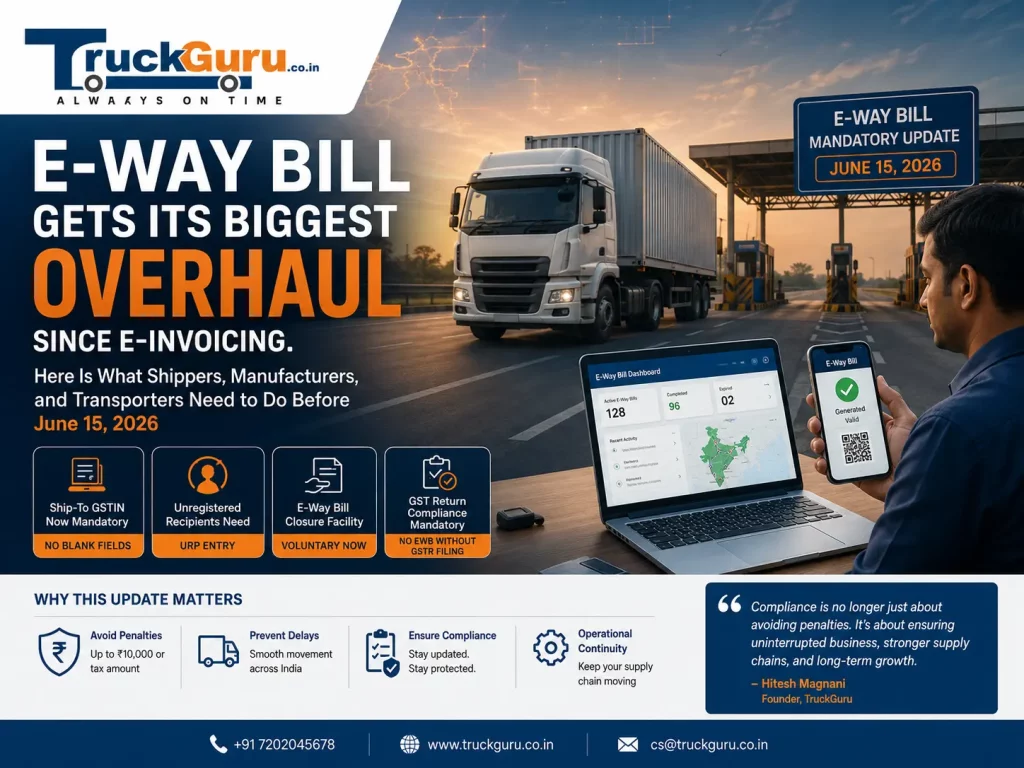
India’s E-Way Bill Gets Its Biggest Overhaul Since E-Invoicing. Here Is What Shippers, Manufacturers, and Transporters Must Do Before June 15.
Executive Summary
On June 15, 2026, GSTN rolls out two significant changes to the E-Way Bill system: mandatory Ship-To GSTIN capture in all Bill-To Ship-To transactions, and a new voluntary E-Way Bill Closure facility. For most businesses, the first change is the one that bites. Dispatch teams that have been leaving the Ship-To GSTIN field blank will find bills rejected at generation — meaning trucks cannot move until the error is corrected. This article explains exactly what is changing, who it affects, what happens to businesses that ignore it, and what operations teams need to do before the deadline.
Key Takeaways
- From June 15, 2026, the Ship-To GSTIN field is mandatory in all Bill-To Ship-To E-Way Bills. Unregistered recipients must be entered as “URP.” Blank fields will be rejected.
- The E-Way Bill Closure facility is voluntary — not a penalty trigger. However, early adoption builds a digital delivery record that reduces future reconciliation disputes.
- E-Way Bill generation has been blocked for GST return defaulters since April 2026. A missed GSTR-1 is no longer just a compliance notice. It stops your trucks.
- Under Section 129 of the CGST Act, a truck detained without valid documentation faces a penalty of 200% of the tax payable on the consignment.
- India’s road freight market is worth USD 136.49 billion in FTL alone in 2026. A documentation error that stops one truck costs far more than the penalty.
Section 1: How India Got Here — From Physical Waybills to a Digital Compliance Grid
Before July 2017, moving goods across India meant carrying a different tax document for every state the truck passed through. A truck running from Ahmedabad to Delhi crossed at least two state borders, each with its own checkpost, its own form, and its own set of interpretations. Clearance at a state border could take two to four hours on a good day. On a bad one, half a day.
Ultimately, GST ended that: one tax, one registration, one framework. The E-Way Bill, introduced nationally on April 1, 2018, replaced every state-level waybill with a single electronic document generated before goods leave the gate. India removed highway checkpoints. Trucks moved faster. Transit times on trunk corridors dropped.
But the system kept tightening. The government made e-invoicing mandatory for large businesses in 2020 and steadily extended it to smaller businesses. E-invoices now auto-populate E-Way Bill details, removing one layer of human error. FASTag data was integrated, allowing officers to cross-check vehicle location against the registered route. ULIP — the Unified Logistics Interface Platform — now connects over 30 government and private logistics systems, creating a freight data grid that was unimaginable five years ago.
As a result, India’s logistics costs, once quoted at 13–14% of GDP, have fallen to approximately 8–10% according to the CII-Knight Frank report and the 2025 NCAER-DPIIT study. That reduction is due partly to infrastructure, partly to GST rationalisation, and partly to digitisation. But it came with a trade-off. The system that reduced friction for compliant businesses made life far harder for those who cut documentation corners. Algorithms now catch what manual checkpost inspectors used to miss.
June 15, 2026, is another step in that direction. Not the last one.
Section 2: The Indian Road Freight Market in 2026 — Why Documentation Errors Are Now Expensive
India’s FTL road freight market is valued at USD 136.49 billion in 2026, projected to reach USD 203.23 billion by 2031 at a CAGR of 8.29%. The broader road freight market — covering all truck movement — sits at USD 167.51 billion. Road accounts for close to 70% of all freight tonnage moved in the country. There is no practical alternative for door-to-door intercity goods transport in most of India’s industrial corridors.
In fact, the corridors doing the heaviest lifting are familiar ones. Delhi-Mumbai, Ahmedabad-Mumbai, Chennai-Hyderabad, Mumbai-Bangalore. These carry automotive components, pharmaceuticals, FMCG, textiles, chemicals, and steel — shipments where a 12-hour delay at a checkpoint does real commercial damage. A garment shipment held in Surat misses a retailer’s delivery window. An automotive component delayed outside Pune creates a line stoppage at an assembler’s plant 900 km away.
The freight digitisation push is also reshaping who gets business. Institutional buyers — large retailers, e-commerce marketplaces, export houses — now audit vendor logistics compliance as part of their supplier qualification. A transporter with a history of checkpoint detentions is a liability. A shipper whose shipments routinely carry documentation mismatches loses vendor status. Compliance is no longer just about avoiding penalties. It is about retaining customers.
Section 3: The June 15 GSTN Changes — What Is Mandatory, What Is Voluntary, and Why the Difference Matters
GSTN’s advisory no. 661, dated May 21, 2026, announced two changes scheduled for production deployment on June 15. They are not the same kind of change, and conflating them causes businesses to either panic needlessly or underestimate the actual risk.
The Mandatory Change: Ship-To GSTIN in Bill-To Ship-To Transactions
In a Bill-To Ship-To arrangement, a seller bills one party but delivers goods to another. A manufacturer in Pune might bill a distributor in Mumbai but deliver directly to the distributor’s client in Nashik. The invoice shows the distributor as the buyer. The truck goes to Nashik.
Until now, you could leave the “Ship To” GSTIN field in the E-Way Bill blank in these situations without triggering a system error. From June 15, you can no longer leave the field empty. You must now enter the GSTIN of the actual delivery recipient — the Nashik party in the example above. If that recipient is unregistered, enter “URP.” No entry means no E-Way Bill generated.
On the surface, this sounds simple. In practice, it catches several common operational gaps:
- A dispatch team filling the E-Way Bill manually does not always know the consignee’s GSTIN. They know the delivery address. The GSTIN sits in a different system, entered by someone else.
- Businesses that dispatch to project sites, construction locations, or temporary warehouses often have unregistered recipients. Those teams have never needed to enter “URP” before because the field was optional.
- Companies doing regular stock transfers to their own branches sometimes have multiple GSTINs for different registration locations and fill in the wrong one by habit.
- Master data left unaudited for months — or years — will have stale GSTINs for consignees who may have surrendered registration, changed registration, or moved locations.
The Voluntary Change: E-Way Bill Closure Facility
The closure feature allows a supplier, recipient, transporter, or authorised driver to formally mark an E-Way Bill as delivered. The mechanism works through the portal, mobile OTP verification, or API integration. The system creates a digital record of delivery completion — distinct from cancellation, which marks a bill as generated in error.
The facility is voluntary. Businesses that do not use it face no penalty. However, those who adopt it early gain a GST reconciliation advantage. Delivery confirmation in the E-Way Bill system creates a timestamp that aligns with invoice settlement, reducing disputes where goods arrive but the buyer delays acknowledgement. It also sets up businesses for what is likely to follow: GST compliance rules have steadily moved from optional to mandatory. The closure facility is almost certainly a preview of a future requirement.
Section 4: What Actually Happens When a Truck Is Detained
The legal framework is precise. Section 122 of the CGST Act imposes a penalty of Rs. 10,000 or the tax sought to be evaded — whichever is higher — on any business that transports taxable goods without a valid E-Way Bill. Section 129 authorises officers to detain and seize the goods and vehicle when they find goods in transit without valid documentation. Post the Finance Act 2021 amendments, effective January 2022, authorities charge a penalty of 200% of the tax payable on detention.
The numbers matter. Consider a pharmaceutical shipment from a Hyderabad manufacturer to a Chennai distributor: goods value Rs. 8.5 lakh, IGST at 12% = Rs. 1.02 lakh tax. A Section 129 detention means a penalty of Rs. 2.04 lakh — before the truck moves an inch. And that assumes the owner comes forward within seven days. If not, the penalty escalates to 50% of the goods’ value or 200% of the tax, whichever is higher.
But the financial penalty is rarely what businesses remember most. The operational consequences are what scar supply chains.
How Detention Plays Out Across Industries
Manufacturing sector: A tier-2 automotive supplier running components from a Pune factory to a Gurgaon assembler cannot recover from a 48-hour detention. The assembler’s production schedule does not flex. The supplier faces a penalty clause in the contract worth more than the CGST fine.
FMCG sector: An FMCG company running a promotional product distribution before the festival season operates on tight delivery windows. A truck with biscuits or beverages detained on the Ahmedabad-Mumbai corridor for documentation issues means out-of-stock shelves, missed promotional placement, and deduction notes from the retailer.
Pharma sector: Cold-chain pharmaceutical shipments have validity windows that have nothing to do with the E-Way Bill. Temperature excursion during an extended detention can make a shipment unsaleable. The commercial loss is the shipment value, not just the penalty.
Retail and e-commerce: Return cargo moving from fulfilment centres back to sellers generates significant freight movement. These are often low-value, mixed-SKU shipments where documentation discipline is weakest — and where a GSTIN mismatch on a bulk return triggers a detention that holds up dozens of sellers’ inventory.
Section 5: The Hidden Cost That No One Calculates
Every logistics manager has a number for checkpoint detention fines. Very few have a number for the indirect costs that those detentions generate.
An idle truck on a long-distance corridor costs the operator a minimum of Rs. 3,000–5,000 per day in fixed costs: driver wages, EMI on the vehicle, insurance, and loss of revenue from the next booking. Consequently, a 48-hour detention costs the operator Rs. 6,000–10,000 before any penalty is paid.
The Costs Your Finance Team Cannot See on a Spreadsheet
Moreover, the shipper’s costs are harder to calculate but larger. Warehouse congestion builds at the destination when expected trucks do not arrive. The warehouse team reallocates labour to manage the backlog, and the next day’s outbound schedule slips. A delayed inbound that disrupts production scheduling creates ripple costs across a production line — machine idle time, worker overtime to recover, expedited air freight for components that should have come by road.
Working capital is also affected. Goods in transit are assets on the balance sheet. When a truck is detained, those assets sit frozen — not yet received by the customer, not yet triggering payment. For businesses running tight credit cycles, a 48–72 hour detention on a high-value shipment can force short-term borrowing to cover the cash gap.
Furthermore, the trucking industry loses an estimated 6–8 hours per trip to manual interventions even without detention, according to KPMG’s Budget 2026 analysis. Documentation errors at checkpoints add to that figure. A fleet operator running 50 trucks on long-distance corridors, each losing even two additional hours per month to documentation-related delays, loses 100 truck-hours of revenue-generating capacity monthly.
Section 6: The E-Way Bill Closure Facility — How It Works and Where It Is Going
The closure facility addresses a gap that has frustrated logistics managers since the E-Way Bill system launched. Once a shipment is delivered, the E-Way Bill sits as an open record in the portal. It expires when its validity runs out, but there is no formal confirmation of delivery. For record-matching purposes, this creates a mismatch: the invoice may be settled, the LR may be signed, but the E-Way Bill record does not reflect delivery completed.
Now, under the new facility, once goods are delivered, any authorised party — the supplier, recipient, transporter, or driver whose mobile number is linked to the bill — can trigger a closure. The process on the portal works through the E-Way Bill number or the generation date. Via mobile, it uses OTP verification. For businesses running API-based ERP integration, API calls will handle closure at scale.
The practical benefit for shippers: a closed E-Way Bill creates a clean digital audit trail. For businesses dealing with GST audits, having a delivery confirmation timestamped in the portal removes one line of questioning from the officer’s checklist.
Adoption challenges are real. Drivers on long-distance runs do not always have smartphones with stable connectivity at the point of delivery. Not all consignees will cooperate with closure requests, particularly for unregistered recipients. ERP vendors and GSPs need to update their systems before the API integration is stable.
Nevertheless, this means businesses should wait. The pattern with GSTN changes is clear: e-invoicing started as mandatory above Rs. 500 crore turnover in 2020, dropped to Rs. 5 crore by 2023, and is now universal for registered businesses. The closure facility is likely on the same path. Businesses that build closure into their delivery workflows now will not need to rebuild anything when it becomes mandatory.
Section 7: Why Compliance Has Become an Operations Function, Not a Finance One
Five years ago, E-Way Bill compliance sat in the finance or accounts team. The dispatch team prepared the paperwork. The accounts team generated the bill. The driver carried a printed copy. The process was a finance workflow with a logistics execution step at the end.
However, that model does not work in 2026. The June 15 changes — particularly the Ship-To GSTIN requirement — require real-time data accuracy at the point of dispatch. The GSTIN of the actual delivery recipient must be known and correct before the truck moves. That data sits in the company’s customer master, not in the accounts system. Keeping it current is an operations responsibility.
“This is the shift most businesses have not made yet. The accounts team generates the E-Way Bill, but the data that goes into it — the delivery address, the vehicle number, the consignee GSTIN — that data is owned by operations. When the operations team does not own the compliance outcome, you get mismatches. And mismatches stop trucks.” — Hitesh Magnani, Founder, TruckGuru
FASTag Has Made Route Compliance Automatic — and Unforgiving
The FASTag integration makes this sharper. A truck’s FASTag records every toll plaza it passes through, along with timestamps. If a vehicle travels on a route that does not match the one on its E-Way Bill — because the driver took a different highway, or because the bill was generated with the wrong destination — the system flags the discrepancy automatically. The driver does not need to stop at a manned checkpoint for this to trigger. It happens in data.
For operations teams, this means three things must be true at the same time: the E-Way Bill must have the right data, the vehicle in Part B must be the vehicle that actually moves, and the route must broadly match the registered destination. Getting all three right every time requires dispatch teams to treat documentation as part of the loading process, not something to sort out after the truck leaves.
Section 8: Expert Commentary — Hitesh Magnani on What SME Shippers Get Wrong
Hitesh Magnani built TruckGuru specifically to serve the segment of the market that gets documentation compliance wrong most often: the SME shipper moving 3–15 tonnes on intercity routes with no dedicated logistics team.
On the most common mistakes:
“The Part B update problem is more common than people think. A truck breaks down. The transporter arranges a replacement vehicle. The driver calls the dispatch office, gets the go-ahead to transfer the load, and the replacement truck moves. Nobody updates Part B in the E-Way Bill because everyone assumes someone else is handling it. The bill has the original vehicle number. The truck that arrives at the checkpoint is a different vehicle. That is an automatic detention trigger.”
On the GSTIN mismatch:
“We see this most with businesses that have multiple GST registrations — a head office and branch registrations in different states. The invoice goes out from the head office GSTIN. The E-Way Bill gets generated by someone in the branch who uses the branch GSTIN. The officer at the checkpoint sees a mismatch between the invoice and the bill. The goods are detained. The shipper is convinced there is a conspiracy. There is no conspiracy. There is a data entry problem.”
On the June 15 change specifically:
“The Ship-To GSTIN requirement will catch businesses that have been doing Bill-To Ship-To without even realising that is what it is called. A lot of SME manufacturers deliver directly to their customers’ end-clients as a service. They invoice the distributor and deliver to the retailer. They have been doing this for years without filling in the Ship-To GSTIN because the field was optional. On June 15, the field is mandatory. If they have not updated their master data to include the end-client’s GSTIN, their dispatch team will be generating rejected bills and not knowing why.”
On digital transformation:
“The businesses that have moved to digital logistics — freight management platforms, digital LR, GPS-linked tracking — are mostly ready for this change because their data is already structured. The businesses still running on WhatsApp messages and handwritten bilties are not. And there are still a lot of them.”
Section 9: How Technology Reduces Compliance Risk in Freight Operations
The compliance errors that stop trucks are rarely the result of bad intentions. They are data errors: the wrong GSTIN, the wrong vehicle number, the expired bill that nobody flagged. Technology addresses each of these at the point where the error happens, not after.
Digital Lorry Receipts (Digital LR): A digital LR on a freight management platform links directly to the E-Way Bill. Consignee data flows from the customer master into the LR, and from the LR into the EWB. The risk of a manual mismatch between the invoice GSTIN and the EWB GSTIN drops significantly when both documents draw from the same data source.
GPS-Integrated Tracking: Additionally, the platform monitors the truck’s GPS position against the route in the EWB. It flags deviations from the declared corridor before they become checkpoint problems. Route deviation alerts allow operations teams to update Part B or generate a fresh EWB before a mobile enforcement squad catches the discrepancy.
Automated Validity Monitoring: An E-Way Bill valid for 11 days on a 2,200 km Delhi-Chennai corridor does not expire the moment it is generated. It expires 11 days after generation. A freight platform that monitors active EWBs against their validity windows can alert the operations team to extend before the clock runs out — rather than leaving that task to the driver.
E-POD (Electronic Proof of Delivery): The driver captures an e-POD at the delivery point — with timestamp, receiver signature, and location data — creating the delivery confirmation record that supports the EWB Closure facility. Businesses already using e-POD have the infrastructure to feed closure data into the portal with minimal additional effort.
Route Intelligence and Transit Time Calculation: The difference between an EWB generated with adequate validity and one that expires mid-journey is usually a transit time estimation error. Freight platforms with route intelligence tools calculate realistic transit time — accounting for loading buffers, overnight stops, and corridor-specific delays — and set validity at the time of booking.
Section 10: The TruckGuru Approach to Freight Compliance
TruckGuru’s platform was designed around the compliance requirements of SME shippers who do not have dedicated logistics teams. Every component of the platform addresses a documented point of failure in transport documentation.
Verified Transporter Network: TruckGuru verifies every transporter for a valid vehicle Registration Certificate, current Fitness Certificate, All-India Permit coverage, and a driver’s license with the correct class endorsement. TruckGuru checks these at onboarding and monitors them for expiry. A transporter whose documents have lapsed does not get bookings until the documents are renewed.
Vehicle-Level Documentation: When a vehicle change happens after booking — due to breakdown or operational reasons — the platform flags the Part B update requirement and walks the transporter through the process. The dispatch team gets notified at the same time so the EWB updates before the replacement vehicle moves.
Automated Validity Calculation: At the time of booking, TruckGuru calculates the minimum E-Way Bill validity required for the route distance, adds a buffer for standard loading and transit variability, and flags shipments where the default validity window falls short of the estimated transit time. This calculation runs against the specific origin-destination pair, not a generic formula.
Digital LR on Every Booking: Every TruckGuru booking generates a digital Lorry Receipt linked to the shipment details, creating an audit-ready documentation trail from dispatch to delivery. TruckGuru timestamps the LR, makes it tamper-proof, and gives both shipper and transporter access.
Live Tracking on All Movements: GPS-enabled tracking gives shippers live position data on every active shipment. Operations teams monitoring a Delhi to Surat 32ft container on a 24-hour run can confirm the vehicle is on the correct corridor and flag any deviation that might require an EWB update.
These tools are not exclusive to TruckGuru — any well-built freight platform should offer them. The point is that compliance in 2026 requires this infrastructure. Businesses running freight on phones and paper are systematically exposed to the documentation errors that stop trucks. Visit the booking and documentation process page at truckguru.co.in/truck-booking-online to see how TruckGuru handles this end to end.
Section 11: June 15 Readiness Checklist — What to Do Before the Deadline
GST Filing Status
- Confirm GSTR-1 and GSTR-3B filings are current for all GSTINs your business holds
- Check whether any supplier or recipient whose GSTIN you regularly use in EWBs has an active GST registration (cancelled supplier GSTINs will cause EWB rejection)
- Set a monthly filing calendar reminder — one missed return blocks EWB generation entirely
Master Data Validation
- Pull all active consignees from your dispatch records for the past 90 days
- Verify the current GSTIN against the GST portal for each one
- Tag unregistered recipients as “URP” in your customer master
- For Bill-To Ship-To situations, map every “Ship To” location to a verified GSTIN or “URP” flag
Internal Process Updates
- Identify every Bill-To Ship-To shipment type in your dispatch SOPs
- Update dispatch forms to require Ship-To GSTIN input before EWB generation
- Circulate a one-page instruction note to dispatch staff covering what changes on June 15 and what to do when a consignee is unregistered
Driver and Transporter Briefing
- Remind all regular transporters of the Part B update requirement on vehicle substitution
- Confirm drivers have digital access to E-Way Bills on their phones — physical copies stay valid, but digital access speeds up checkpoint queries
- Brief transporters on the EWB Closure facility so drivers understand that a delivery closure request from the platform is not a penalty or cancellation
Technology Audit
- If your ERP or freight management system generates E-Way Bills via API, confirm your vendor has deployed the June 15 API changes in the production environment
- Test a Bill-To Ship-To EWB in the GSTN sandbox with the Ship-To GSTIN field filled in to confirm your system handles it correctly
Validity Planning for Long-Distance Lanes
- For every corridor above 1,000 km, calculate the minimum validity needed: divide the distance by 200 and add at least 2 days buffer
- Delhi to Mumbai (1,400 km): minimum 7 days + 2 buffer = 9 days validity
- Delhi to Chennai (2,200 km): minimum 11 days + 2 buffer = 13 days validity
- Mumbai to Kolkata (2,050 km): minimum 11 days + 2 buffer = 13 days validity
Contingency Plan
- Identify who in your organisation has login access to the E-Way Bill portal to handle extensions and corrections outside business hours
- Keep the GST helpline number (1800-103-4786) accessible to dispatch and transport supervisors
Section 12: Where Freight Compliance Is Heading — The Next Three Years
The June 15 changes are not a peak. They are a point on a curve.
The GST Council has been systematically closing every manual gap in the E-Way Bill system since 2018. Auto-population from e-invoices removed one class of data entry errors. FASTag integration added real-time location verification. The GSTR return linkage, effective in 2026, tied compliance status directly to operational access. The Ship-To GSTIN mandate closes the last major field that businesses could leave blank in a commercial transaction.
The Next Mandatory Change: EWB Closure
Furthermore, what follows is likely to include mandatory EWB Closure — a formal delivery confirmation requirement that creates a complete digital lifecycle for every shipment above Rs. 50,000. Once the voluntary facility has been running long enough to build systems and habits across the industry, mandatory closure becomes straightforward to enforce.
AI Risk Scoring Is Already Live at Enforcement Checkpoints
AI-based risk scoring at enforcement has already started. Mobile enforcement squads in several states now use algorithmic flagging to prioritise which trucks to intercept, based on route deviation, historical compliance records, shipment value, and sector-specific risk profiles. A business with a clean EWB history gets less scrutiny. A business with repeated mismatches gets more. The compliance record you build now affects the checkpoints your trucks face later.
What This Means for Businesses That Get Compliance Right
For shippers, manufacturers, and transporters who treat documentation as an operational discipline — not a paperwork obligation — none of this is threatening. The direction is clearly toward a system where goods with correct documentation move with less friction, and goods with poor documentation stop more often. That is, roughly, how a compliance system is supposed to work.
Frequently Asked Questions
Q1. What exactly is a Bill-To Ship-To transaction?
A Bill-To Ship-To transaction is one where the invoice goes to one party (the buyer), but the goods are physically delivered to a different address — often the buyer’s customer, a project site, or a branch location. From June 15, you must enter the Ship-To party’s GSTIN in the E-Way Bill. If they are unregistered, enter “URP.”
Q2. My supplier generates our E-Way Bills. Does this change affect me?
Yes. Your supplier needs your Ship-To GSTIN if the delivery address differs from your invoice address. If they do not have it, the bill will fail to generate, and your truck will not move. Confirm your GSTIN data is on file with every supplier who delivers directly to your locations or customers.
Q3. We do a lot of stock transfers between our own branches. How does this apply?
Branch transfers use Delivery Challans rather than Tax Invoices, but you still need E-Way Bills for movements above Rs. 50,000. If the branch receiving the goods has a separate GSTIN (which is common for businesses registered in multiple states), that GSTIN must now appear in the Ship-To field. Confirm you have all your own branch GSTINs correctly entered in your dispatch system.
Q4. What is the penalty if our truck stops with a blank Ship-To GSTIN field after June 15?
A blank Ship-To GSTIN causes EWB generation to fail, so the truck cannot move without correcting the field first. If officers find a truck in transit on a bill generated before the system enforcement — or on a fraudulent document — they can detain it under Section 129 of the CGST Act, with a penalty of 200% of the tax payable on the shipment.
Q5. Can we extend an expired E-Way Bill at a checkpoint?
You can request an extension starting 8 hours before expiry up to 8 hours after expiry. A bill that expired more than 8 hours ago cannot be extended. The truck is then in transit without a valid EWB and is subject to detention. Extension requires a valid reason: vehicle breakdown, natural calamity, trans-shipment delay, or law-and-order disruption.
Q6. The voluntary EWB Closure facility — does anyone actually need to use it right now?
No immediate penalty risk for not using it. However, businesses that adopt it now gain two advantages: a digital delivery confirmation trail that simplifies GST record-matching, and operational readiness for when it becomes mandatory, which, based on the direction of GSTN changes, is likely within 2–3 years.
Q7. Our ERP generates E-Way Bills via API. What do we need to check?
Your ERP vendor or GSP needs to have deployed the updated API specifications from GSTN in the sandbox environment. The Ship-To GSTIN field must be part of your EWB generation call for Bill-To Ship-To transactions. Run a test transaction in the sandbox before June 15 to confirm the new field passes correctly.
Q8. Does this change affect the 14ft Eicher or smaller vehicles like the Tata Ace?
The June 15 changes apply to all E-Way Bills regardless of vehicle type. An Eicher 14ft moving 3.5 tonnes on a Vadodara to Surat run — well above Rs. 50,000 in most cases — requires a valid EWB with all mandatory fields. The Ship-To GSTIN requirement applies to the shipment, not the vehicle size. See the full fleet range at truckguru.co.in/truck-size, covering all vehicle classes from Tata Ace to 32ft container.
Q9. We dispatch to project sites where the client has no GST registration. What do we enter?
Enter “URP” (Unregistered Person) in the Ship-To GSTIN field. The system accepts this as a valid entry. Do not leave the field blank — that will cause the bill to fail after June 15.
Q10. How far in advance should we generate an E-Way Bill for a Delhi to Mumbai truck?
The Delhi-Mumbai distance is approximately 1,400 km. At one day per 200 km, that is 7 days of minimum validity. Generate with at least 9 days of validity to cover loading delays, traffic on the Mumbai approach, and any minor route changes. Generate the bill on the day of dispatch, not days in advance — validity begins from generation, not from departure.