

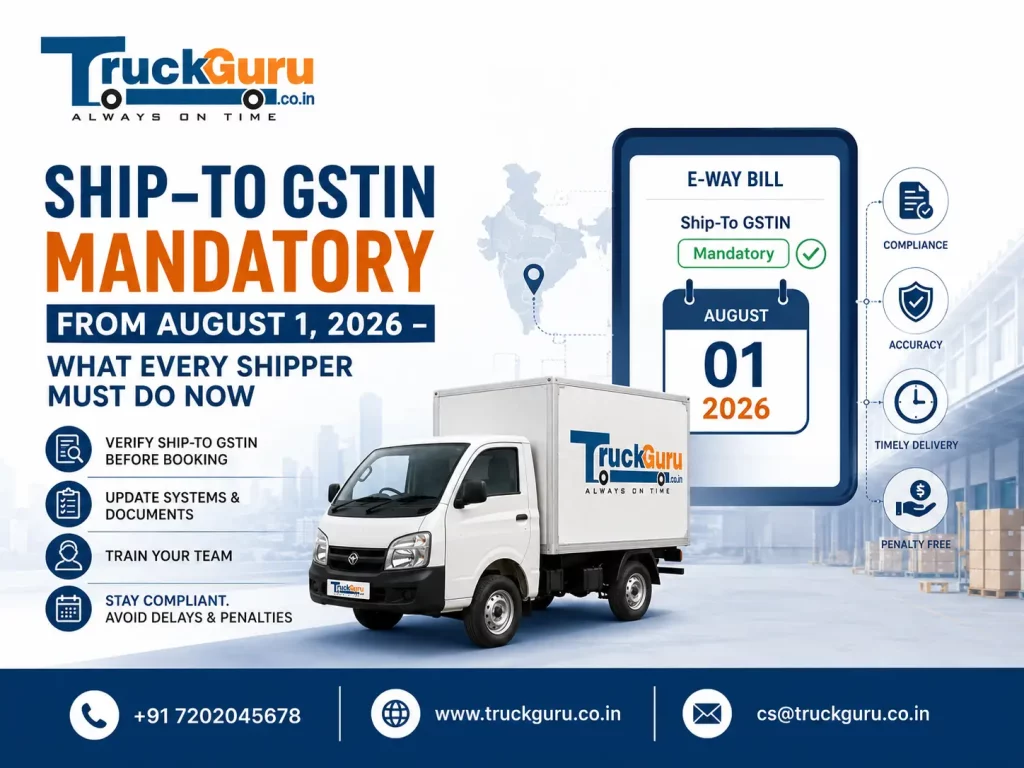
Ship-To GSTIN Mandatory from August 1, 2026 — What Every Shipper Must Do Now
Published: July 2026. Based on GSTN Advisory No. 661 (May 21, 2026) and Advisory No. 664 (June 17, 2026). Verify details at gst.gov.in as the advisory has been revised multiple times. From August 1, 2026, every B2B e-way bill generated for a Bill-To/Ship-To transaction must include the GSTIN of the entity at the delivery address. Miss that field, and the e-way bill will not generate. The truck does not move.
This is not a minor system update. It is a structural change to how the GSTN validates freight documentation in India. GSTN Advisory No. 661 (issued May 21, 2026, effective date later deferred from June 15 to August 1) sets out the requirement clearly: in any transaction where goods are delivered to an address different from the billing address, the Ship-To GSTIN is now a mandatory field at IRN and e-way bill generation.
If you ship goods from your manufacturing unit to a distributor’s warehouse, from a supplier to a project site, or from any origin to a delivery point that is not the billed entity’s registered address — this applies to you.
What Changed and Why
Before this advisory, the Ship-To field in the e-way bill was optional. Businesses could generate an e-way bill with only the Bill-To party’s GSTIN and leave the delivery details incomplete. The GSTN system accepted it.
That created two problems GSTN has been trying to close. First, the audit trail broke at the point of delivery. If goods were invoiced to Company A but physically delivered to Company B’s warehouse in another state, the GST system had no way to cross-verify whether the delivery actually occurred at a registered, identifiable location. Second, e-way bills stayed active in the system long after goods were delivered, goods were returned, or the transaction was cancelled entirely. An open e-way bill with no delivery confirmation is a compliance gap that department scrutiny can exploit.
Advisory No. 661 fixes both. Mandatory Ship-To GSTIN closes the first gap. The voluntary E-Way Bill Closure facility — introduced alongside it — closes the second.
Who This Affects
The mandate applies to B2B and SEZ transactions where the delivery point differs from the billing address. In practice, most of the businesses most affected are exactly the kind of companies that use intercity freight most heavily:
- Manufacturers shipping to distributor warehouses in other states
- Traders supplying to retail chain distribution centres
- FMCG companies delivering to regional fulfilment hubs not registered at the billing GSTIN
- Pharma companies shipping to hospital procurement points or stockist locations
- Auto component suppliers sending parts to OEM assembly locations are registered separately from the procurement office
If your billing address (the entity you invoice) and your delivery address (where the truck actually drops the goods) are different — and especially if they are in different states — the Ship-To GSTIN mandate directly affects every shipment you run.
What Happens at the Technical Level
The validation happens at IRN generation and at e-way bill creation. When you submit invoice details to the Invoice Registration Portal (IRP), the system will now check whether the Ship-To GSTIN field is populated wherever shipping details are present. The GSTN validation engine applies four checks:
- Ship-To GSTIN is blank when the Ship-To address differs from the Bill-To address and the recipient is GST-registered — e-way bill generation may fail
- Ship-To GSTIN entered does not exist in the GSTN database — rejected
- Ship-To GSTIN is registered but currently cancelled or suspended — rejected
- Ship-To GSTIN does not match the state in the Ship-To address (state code mismatch) — rejected
Any one of these conditions fails the invoice upload. No IRN generated. No e-way bill generated. No movement is covered.
One additional rule from Advisory No. 664 (June 17, 2026): in B2B and SEZ transactions, the Ship-To GSTIN set at IRN generation cannot be amended during e-way bill creation. The value is locked at the IRN stage. This means getting it wrong at invoice generation is not fixable downstream.
What to Enter for Unregistered Consignees
Not every delivery point has a GSTIN. A small trader, a project site, an individual recipient — these are unregistered persons under GST. The advisory is explicit: enter “URP” (Unregistered Person) in the Ship-To GSTIN field. The portal accepts it. Do not leave the field blank. Blank and URP are treated differently — blank triggers a validation failure, URP does not.
The E-Way Bill Closure Facility — What It Is and Why It Matters
Alongside the Ship-To GSTIN mandate, GSTN introduced a voluntary E-Way Bill Closure facility. Once goods are delivered — or in cases where an e-way bill was created by mistake, contains errors, or covers a transaction that never materialised — the supplier, recipient, transporter, or authorised driver can formally close it in the system. Closure must happen on the same day of delivery or the immediately following day (D or D+1).
This is currently voluntary — no penalty for not using it today. But it is worth building into your delivery workflow now for two reasons. First, closed e-way bills create a cleaner audit record. If a department officer queries a completed shipment, a closed e-way bill with a delivery confirmation timestamp is better than an expired one with no closure record. Second, the industry expectation is that this will eventually become mandatory. The regulatory architecture is already in place.
Closure can be done through the e-way bill portal after login, through the mobile number-OTP facility (where the driver or authorised representative can close before login), or through API integration. The e-way bill number is the key input.
5 Steps to Get Ready Before August 1
Step 1 — Audit every delivery point in your customer master
Pull a list of all Ship-To addresses your business uses. For each one, verify the GSTIN registered at that address. A legal entity with presence in multiple states has a separate GSTIN per state — a Delhi company delivering to its Gujarat warehouse needs the Gujarat GSTIN, not the Delhi one.
Step 2 — Validate every Ship-To GSTIN before August 1
Use the GST portal’s “Search Taxpayer” tool or the GSTN API to confirm each GSTIN is active and the state code matches the delivery address. A GSTIN that was valid six months ago may have been cancelled or surrendered. Do not assume — verify.
Step 3 — Update order forms and sales order workflows
If your sales team captures delivery addresses informally — in notes, emails, or verbal confirmations — add a structured Ship-To GSTIN field to your order form before August 1. The GSTIN must be on the invoice before it is raised, not added as a correction after the fact. Corrections are not possible once the IRN is generated for B2B/SEZ transactions.
Step 4 — Update ERP and billing system configuration
If you use ERP software (SAP, Tally, Zoho, or any GST-integrated system), ensure the Ship-To GSTIN field is mapped correctly in your invoice and e-way bill generation workflow. GSTN has updated APIs in the Sandbox environment — your ERP vendor or GSP should have completed testing already. Confirm this with them before August 1.
Step 5 — Train your logistics and billing teams
The people raising invoices and generating e-way bills need to understand that Ship-To GSTIN is now a required field, not optional. A single blank field blocks the entire movement. For unregistered consignees, they need to know to enter “URP” — not leave it blank, not enter the billing GSTIN, not skip the field.
What This Means for Freight Documentation at Dispatch
For businesses that book intercity FTL trucks, the Ship-To GSTIN mandate adds one critical step before dispatch: the e-way bill cannot be generated until the Ship-To GSTIN is confirmed and validated. The truck cannot leave without a valid e-way bill covering the full route.
This means dispatch teams need the Ship-To GSTIN confirmed before the truck arrives at the loading dock — not after. A truck waiting at the loading while the accounts team searches for a delivery-point GSTIN is a real and avoidable problem. Build the GSTIN verification step into your pre-dispatch checklist now, not on August 2.
For intercity FTL bookings, TruckGuru confirms driver name and vehicle number before dispatch — giving you the transporter details needed to generate an accurate e-way bill. Check current rates on the freight calculator.
Key Takeaways
- GSTN Advisory No. 661: Ship-To GSTIN mandatory in all Bill-To/Ship-To e-way bills from August 1, 2026
- Applies to B2B and SEZ transactions. Export transactions are excluded.
- Blank Ship-To GSTIN field blocks IRN generation. In Bill-To/Ship-To cases covered by the advisory, a failed Ship-To GSTIN validation can stop e-way bill generation and delay dispatch.
- For unregistered consignees: enter “URP” — not blank.
- Ship-To GSTIN is locked at IRN stage for B2B/SEZ — cannot be amended during e-way bill creation.
- Voluntary EWB Closure facility introduced alongside — D or D+1 window after delivery.
- Action required before August 1: audit delivery-point GSTINs, update ERP, and train billing teams.
FAQ
What is Ship-To GSTIN in an e-way bill?
Ship-To GSTIN is the GST registration number of the entity at the delivery address. In Bill-To/Ship-To transactions where goods are invoiced to one party but delivered to a different address, the delivery location must now be identified by its GSTIN in the e-way bill. This is mandatory from August 1, 2026 under GSTN Advisory No. 661.
What happens if the Ship-To GSTIN is missing from August 1, 2026?
The e-way bill will not generate. The invoice and e-way bill flow may be rejected if the mandatory Ship-To GSTIN data is missing or invalid. Non-compliance of goods worth above Rs. 50,000 without a valid e-way bill may attract detention, penalty, or confiscation under the CGST Act (Sections 129 and 130), depending on the nature and intent of the violation.
What should I enter if the consignee is unregistered under GST?
Enter “URP” (Unregistered Person) in the Ship-To GSTIN field. The portal accepts URP as a valid entry for consignees who do not have a GST registration. Leaving the field blank will trigger a validation failure — URP is the correct alternative.
Can I correct the Ship-To GSTIN after generating the IRN?
No. For B2B and SEZ transactions, the Ship-To GSTIN entered at IRN generation is locked and cannot be amended during e-way bill creation. Per Advisory No. 664 (June 17, 2026), the value set at the IRN stage is final. Get it right before raising the invoice.
Does the Ship-To GSTIN mandate apply to export transactions?
No. Export transactions are excluded from the mandatory Ship-To GSTIN requirement. The mandate applies to B2B and SEZ supply transactions only.
What is the E-Way Bill Closure facility, and is it mandatory?
The EWB Closure facility allows suppliers, recipients, transporters, or authorised drivers to formally close an e-way bill once goods are delivered. Closure must happen on the same day of delivery or the next day (D or D+1). It is currently voluntary — no penalty for non-compliance today — but industry expectation is that it will become mandatory in a future advisory.
Related Reading
- Reduce Manufacturing Freight Costs: India Intercity Guide
- Reduce B2B Freight Costs in India: 25 Proven Strategies
- Common Questions FTL Shippers Ask Before Booking a Truck
For current rules and official notifications, see the official GST portal.