

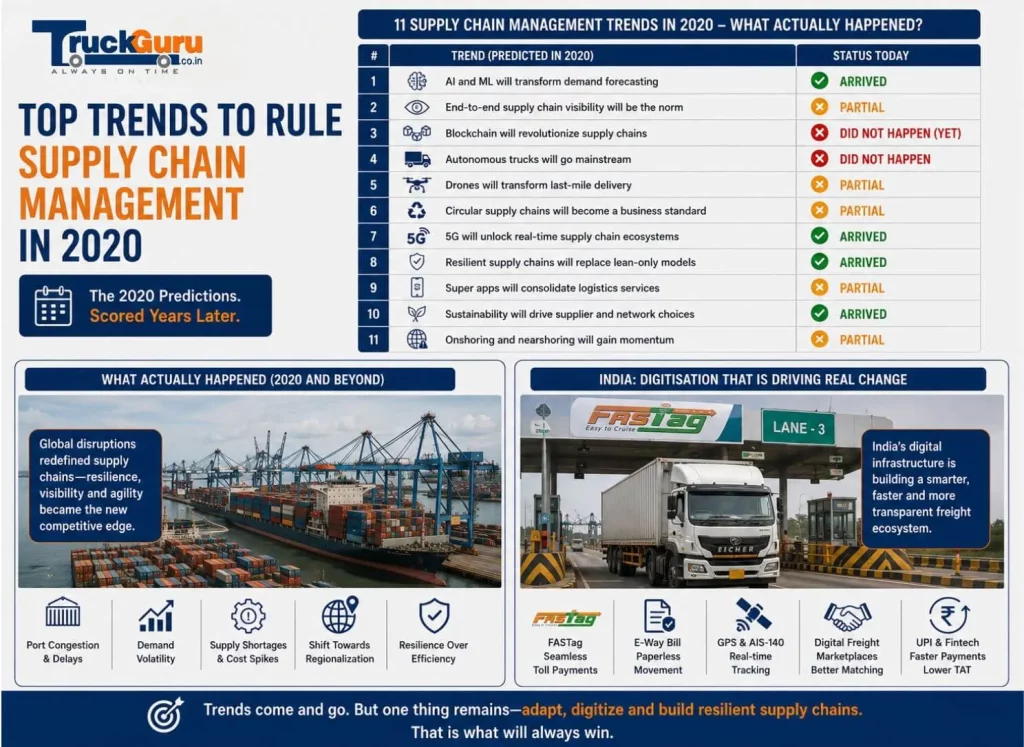
The Supply Chain Management Trends Predicted for 2026, Scored Years Later
Every industry publishes a trends list in January. Almost nobody goes back to check.
Supply Chain Management Trends: Quick Summary
Supply chain management trends predicted for 2026, scored years later. What arrived, what quietly died, and what nobody in the industry saw coming.
This page originally carried a set of supply chain management trends predicted for 2026. Enough time has passed to mark them, and the marking is more useful than another forecast, because the pattern in what survived tells you something about which predictions to trust next time.
One thing worth saying before the list. Not a single item on it anticipated what actually defined the period: a pandemic, container shortages, ocean freight rates at multiples of normal, and supply chains rebuilt around resilience rather than efficiency. The biggest force in modern supply chain history arrived without appearing on any January list. Keep that in mind whenever you read one.
The scorecard: eleven supply chain management trends, marked
Artificial intelligence
Arrived, but not as described. The 2026 pitch was AI for demand forecasting, route optimisation and predictive maintenance. Forecasting and routing did become genuinely useful. Then large language models arrived from late 2022 and changed the conversation entirely, in a direction none of these lists predicted. The prediction was right about the label and wrong about the shape.
Internet of Things
Arrived narrowly, and by mandate. In India, the sensor technology that reached scale did so because regulation required it, not because operators chose it. FASTag RFID at toll plazas and AIS-140 vehicle location tracking are on the fleet. Cargo-level sensing beyond pharma and high-value goods largely is not.
Covered in detail in applications of IoT in transportation and logistics.
Advanced analytics
Arrived quietly. The least glamorous item on the original list turned out to be the most correct. Analytics on procurement, inventory and freight spend became ordinary practice at mid-size and larger operations. No branding, no conference circuit, just steady adoption because the return was measurable.
Robotic process automation
Overtaken. RPA was pitched as the answer where a counterparty offered no API. That framing dated badly. APIs proliferated, and later language models absorbed a good share of the document-handling work RPA was sold for. The category did not fail so much as get bypassed.
Social media in supply chain management
Did not happen. The prediction that supply chain managers would use social media as a primary channel for connecting with consumers was a category error. Social media matters to brands and customer service. It is not a supply chain function, and treating it as one in a logistics trends list was filler.
Blockchain
Did not happen. The clearest failure on the list. The flagship freight project, TradeLens, was discontinued after failing to reach viable industry participation. The technology worked. The requirement that competitors fund a shared standard did not.
The full account is in blockchain in freight.
Digital supply chain twin
Partial, at the top end only. Real and useful for large manufacturers with the data maturity to build one. Irrelevant to the vast majority of operators, and entirely irrelevant to a road freight business moving consignments between two cities.
Omnichannel
Arrived in retail, not in freight. Retail distribution genuinely reorganised around omnichannel fulfilment. That reshaped warehousing and last mile. It changed very little about intercity full truck load movements, which is the segment this site serves.
Business events
Never a trend. The original entry described ordinary business transactions in abstract language. It was vague when written, and there is nothing to score.
End users as top priority
Not a trend either. Advice to make software usable and pages load quickly is reasonable, but it is not a supply chain development. Two of the eleven items on this list were padding, which is itself worth noticing about trends lists.
Immersive AR and VR
Did not happen. Warehouse picking pilots exist. Nothing reached ordinary logistics operations, and in Indian road freight the concept never had a route to adoption.
What the pattern in these supply chain management trends tells you
Score the eleven supply chain management trends and a shape emerges. Three arrived properly, three arrived narrowly or in a different form, three did not happen, and two were never predictions at all.
The ones that landed share a feature: an identifiable party captured the benefit and could fund it alone. Analytics pays back to the company that buys it. Forecasting pays back to the company that runs it. The ones that failed needed coordinated adoption across parties who compete with each other, and nobody wanted to fund the shared layer.
That is a useful filter for the next list you read. Ask who pays and who benefits. If the answer requires your competitors to cooperate, discount it heavily.
What actually changed Indian freight in that period
Not from the list, and mostly regulatory.
- E-way bill put consignment movements above a threshold value onto a national electronic system under GST.
- FASTag digitised toll collection across national highways, cutting plaza queue time and making per-trip toll auditable.
- AIS-140 brought vehicle location tracking into specified commercial vehicle categories.
- Booking platforms shortened load discovery, which cut empty running for small operators who previously depended on knowing brokers in the destination city.
For official sector data, the Ministry of Road Transport and Highways publishes the figures.
Every item on that list changed daily operations more than anything on the original trends list did. None of them was exciting enough to make a January feature.
Where TruckGuru sits
TruckGuru does not run AI systems, blockchain or IoT infrastructure. It runs full truck load intercity freight across 110-plus cities in India, with the vehicle type, route and rate stated before loading, toll included in the quoted fare, and payment staged across confirmation, loading and delivery with no cash accepted.
That is deliberately ordinary, and it addresses the disputes shippers actually have. See logistics service for the current scope.
Key takeaways
- Of eleven supply chain management trends predicted for 2026, roughly three arrived as described.
- Analytics was the quiet success. Blockchain was the clear failure.
- Predictions that required competitors to fund a shared standard consistently failed.
- No item on the list anticipated the disruption that actually defined the period.
- Indian freight changed mainly through regulation: e-way bill, FASTag and AIS-140.
- When reading any trends list, ask who pays and who captures the benefit.
Frequently asked questions
Which supply chain management trends predicted for 2026 were correct?
Advanced analytics was the most accurate. AI arrived but in a different form than predicted. IoT arrived in India mainly through regulatory mandate rather than commercial choice.
Did blockchain work in supply chain management?
Not at scale in freight. The largest project, TradeLens, was discontinued after failing to reach the industry participation it needed. Narrow uses around provenance and cross-border documentation continue.
Is AI used in supply chain today?
Yes, in demand forecasting, route planning and document handling. The shape differs from the 2026 prediction, largely because language models arrived afterwards and redirected the field.
What changed most in Indian freight since 2026?
Regulatory digitisation. The e-way bill system, FASTag toll collection and AIS-140 vehicle tracking altered daily operations more than any technology on the original trends list.
Why do trends lists get things wrong?
They tend to favour technologies with vendors promoting them over changes with no obvious seller. They also assume coordinated adoption, which fails when the parties involved compete.
Does omnichannel affect full truck load freight?
Barely. Omnichannel reorganised retail fulfilment, warehousing and last-mile delivery. Intercity full truck load movements between two business locations were largely unaffected.
Reading the next list
The next trends article you read will contain a similar mix: a few things that arrive quietly, a few that need cooperation nobody will fund, and a couple of entries that are not predictions at all. The filter is the same. Who pays, who benefits, and does it work if only one company adopts it?
Related Reading
- How to Estimate Goods Transport Rates: A Beginner’s Guide
- How Are Truck Transportation Charges Calculated in India?
- 6 Truck Booking Platforms Compared for FTL Freight in India: FR8, WheelsEye, Trukky, BlackBuck, Vahak & TruckGuru
For current rules and official notifications, see the Ministry of Road Transport & Highways.