

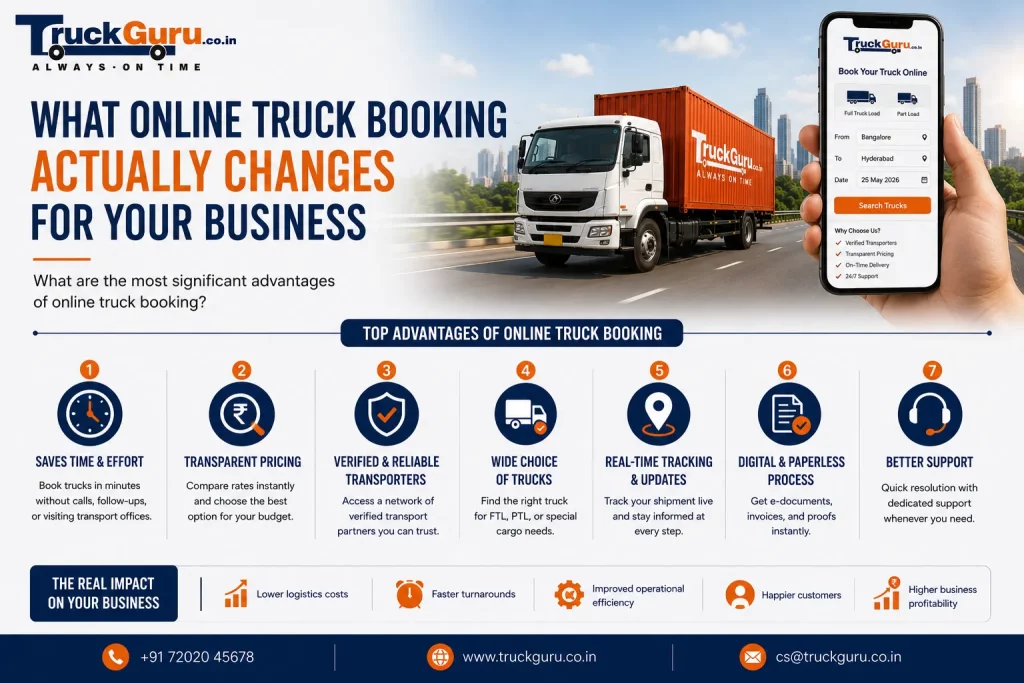
What Online Truck Booking Actually Changes for Your Business
Most of what makes phone-based truck booking slow is not the trucking itself — it is the back-and-forth before a truck ever gets booked. Calling two or three contacts, waiting for callbacks, and getting a verbal price that may or may not hold by the time the truck shows up. Online truck booking removes that sequence rather than replacing it with something equally slow in a different format.
Online Truck Booking: Quick Summary
Get smarter, faster logistics with online truck booking. Enjoy real-time tracking, fair pricing & easy booking for any load. Experience hassle-free transport—book now!
What follows is what actually changes when a business switches to booking trucks online, without inflating any of it with numbers that cannot be traced back to a real source.
1. You Pick the Truck That Actually Matches Your Shipment
With an online platform, the truck size options are visible upfront rather than whatever happens to be available from whichever contact answers the phone first. A small batch going intercity gets a Tata Ace or Bada Dost. A larger dispatch gets a 14ft or 20ft truck. Bulk freight gets a 32ft container. Matching the truck to the actual load weight, rather than defaulting to whatever was available, is the most direct way to avoid paying for capacity that goes unused.
2. You Know the Cost Before You Commit
A platform with a published rate card shows the cost for your route and truck size before you book, not after the truck has already loaded. On TruckGuru specifically, the rate confirmed at booking is the rate on the invoice after delivery — there is no separate negotiation step where the number might shift. You can compare TruckGuru’s own truck-size options against each other for your shipment, which is a different thing from gathering competing quotes from several separate companies — on a fixed-rate platform, there is nothing to negotiate, just a size to choose correctly.
Check a rate on the freight calculator.
3. The Booking Itself Takes Less Time
Entering pickup and delivery details, selecting a truck size, and confirming a booking online takes a few minutes. The time saved is not in the trucking — the truck still takes the same hours to make the trip — it is in everything that used to happen before the truck was even booked: the calls, the waiting, the back-and-forth to settle on a price. For a business booking shipments regularly, that adds up over a month in a way that is easy to underestimate until you stop doing it.
4. You Can See Where Your Shipment Actually Is
Live GPS tracking means checking an app rather than calling the driver to ask. This matters most for planning on the receiving end — knowing a truck is three hours out lets a warehouse team schedule unloading staff accurately instead of guessing, and it lets you give a customer a delivery window based on the truck’s actual position rather than an estimate made at dispatch and never updated.
5. You Work With Transporters Running More Organised Operations
A transport partner using digital booking and tracking tools internally tends to run a tighter operation — pickups on schedule, fewer last-minute surprises, clearer communication when something does shift. This is less about any single feature and more about the discipline that digital tools tend to impose on an operation that would otherwise run on memory and phone calls.
6. Your Shipping History Is There When You Need It
Every booking made through an online platform is recorded automatically — the route, the rate, the invoice, the delivery confirmation. Pulling up last month’s shipments or a specific invoice does not require digging through paper files or chasing a transporter who may not prioritise sending it. For a finance team reconciling freight costs at month-end, having this already organised digitally removes a recurring piece of manual work.
7. You Deal With the Platform Directly, Not a Chain of Contacts
Traditional broker-based booking often runs through one or more intermediaries between the shipper and the actual transporter, each adding their own margin. Booking directly through a platform removes that layered markup. On a confirmed-rate platform like TruckGuru specifically, this does not mean negotiating terms directly with a driver — the rate is fixed by truck size and route, set before you book, the same for every customer on that route. What it does mean is that the price you see has fewer hands taking a cut along the way.
Choosing a Platform That Actually Fits How You Work
A few things are worth checking before settling on any online truck booking platform: whether its vehicle range actually matches what you typically ship, whether pricing is shown clearly before booking rather than after, whether tracking is something you can actually use rather than a feature that exists on paper, and whether support responds when something needs attention. The platform should fit into how your business already operates rather than asking you to change your process to suit it.
TruckGuru covers Tata Ace through 32ft container bookings with a published rate card, GPS tracking, and digital documentation. Check a rate or book directly at TruckGuru.co.in.
Frequently Asked Questions
What are the most significant advantages of online truck booking?
The clearest ones are knowing the cost before you commit, choosing the right truck size for your actual load, spending less time on the booking process itself, and being able to track the shipment rather than calling for updates. Together, these remove most of the friction in traditional phone-based booking.
How does online truck booking work for businesses?
Enter pickup and delivery locations, select a truck size based on your shipment weight, see the confirmed rate, and book. The platform provides driver and vehicle details before dispatch and live tracking through delivery.
Is online truck booking more affordable than booking through a broker?
It depends on what you are comparing. A fixed-rate platform removes layered broker markup and price uncertainty, which is valuable even when the headline number is not always the lowest possible price. The real saving is in predictability and in cutting the time spent arranging each booking.
What truck sizes are available for online booking?
On TruckGuru: Tata Ace (750 kg), Bada Dost (1.5 tonnes), 14ft truck (3.5 tonnes), 20ft truck (7 tonnes), and 32ft container (15 tonnes). Match the size to your actual shipment weight rather than defaulting to whatever feels safe.
Is insurance included when booking a truck online?
Not automatically, on most platforms, including TruckGuru. The confirmed rate covers the freight booking itself — arrange cargo insurance separately before dispatch if your shipment needs it.
Can I track my shipment after booking online?
Yes. Live GPS tracking is standard on most online truck booking platforms, including TruckGuru, showing the truck’s location and estimated arrival throughout the trip.
Call 72020 45678 or book online at truckguru.co.in for a confirmed rate on your next shipment.
Related Reading
- Reduce Manufacturing Freight Costs: India Intercity Guide
- Reduce B2B Freight Costs in India: 25 Proven Strategies
- Ship-To GSTIN Mandate August 2026 — What Shippers Must Do
For current rules and official notifications, see the Ministry of Road Transport & Highways.