

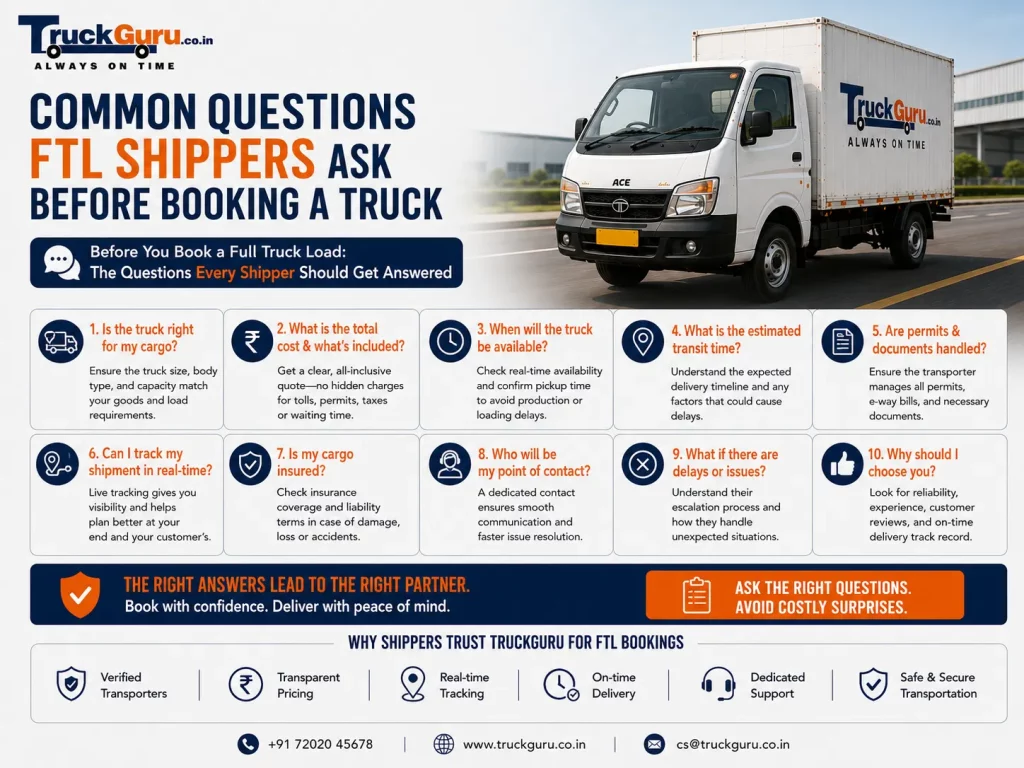
Before You Book a Full Truck Load: The Questions Every Shipper Should Get Answered
Most businesses book their first full truckload freight with at least a few unanswered questions in the back of their mind. How is the price worked out? Which truck size actually fits the load? What happens if the vehicle runs late? Who is responsible if something gets damaged?
These are not niche concerns. They come up on almost every first FTL booking, and often on repeat bookings too, when a shipper is switching from an old arrangement or moving goods on a corridor they haven’t used before.
This article answers the questions that FTL shippers ask most often before confirming a truck booking — covering pricing, documentation, vehicle selection, transit time, and what to expect at the loading and unloading stage. The goal is to give shippers enough working knowledge to make a confident booking decision, not to cover every edge case in Indian freight law.
How Is FTL Freight Priced?
Full truckload freight is priced per trip, not per kilogram or cubic foot. The rate covers the entire vehicle for a single consignment, regardless of whether the truck runs at its full rated capacity or not.
Several factors go into what a trip costs:
- Distance and corridor: longer routes cost more. Routes with strong return-load activity tend to be priced more competitively than corridors where trucks run empty on the return leg.
- Vehicle type: A 32ft container trip costs more than a Tata Ace trip on the same route, because the vehicle, fuel, and operating costs are different.
- Toll charges: these vary by route and vehicle class and are usually either included in the quoted rate or listed as a separate line item.
- Fuel: fluctuations in diesel prices can affect rates, particularly on longer corridors.
- Demand and availability: peak seasons or tight fleet availability on a specific corridor can push rates up.
On a platform like TruckGuru, final trip rate ranges are shown upfront before booking, so the comparison happens before confirmation rather than after the invoice arrives. That is the practical difference between rate transparency and a post-booking surprise.
Which Truck Size Do I Need?
Vehicle selection is one of the most common places shippers waste money, usually by booking larger than the load requires. The right truck is the smallest one that fits the load comfortably at its rated capacity.
TruckGuru’s intercity fleet covers five vehicle types, each suited to a different load range:
- Tata Ace (750kg load capacity): light, time-sensitive intercity loads. Works for small-batch components, samples, or low-weight high-value goods.
- Bada Dost (1.5T load capacity): a step up for slightly larger consignments that still don’t justify a 14ft truck.
- 14ft truck (3.5T load capacity): the most common choice for mid-size manufacturing and distribution loads — auto components, textile rolls, packaged FMCG.
- 20ft truck (7T load capacity): standard full truckload for industrial goods, consumer durables, and distribution bulk stock.
- 32ft container (up to 15T load capacity): high-volume or dense loads — steel, building materials, large FMCG volumes, bulk raw materials.
Two practical checks before selecting: total weight of the consignment, and total volume packed for transport. Weight hits the rated capacity limit first for dense goods; volume fills the truck first for light, bulky goods. Whichever constraint binds first determines the minimum truck size needed.
What Documents Are Needed for Intercity FTL Freight?
Documentation requirements for intercity freight in India are primarily driven by GST compliance. The core set most FTL shippers need to have ready:
- E-way bill: mandatory for goods valued above Rs. 50,000 moving between states (and for some intra-state movements). Generated on the GSTN portal before the truck departs.
- GST invoice: the tax invoice from the supplier to the buyer, which accompanies the goods.
- Lorry receipt (LR): the transport document issued by the carrier at the time of loading, confirming handover of goods.
- Consignor and consignee GSTIN details: required on the e-way bill. Since August 2026, the Ship-To GSTIN on the e-way bill must reflect the actual delivery point, not just the billing address.
- Vehicle registration and driver documents: the transporter handles these, but it’s worth confirming they’re current before the truck departs, particularly for long-distance intercity movements.
For regulated goods — chemicals, pharmaceuticals, food products — there may be additional permits or declarations required depending on the specific material and the states the route passes through. The GST invoice and e-way bill cover the compliance baseline for most standard intercity FTL freight.
What Is the Difference Between FTL and Shared Load Transport?
Full truckload freight means one shipper’s consignment occupies the entire truck. The vehicle moves directly from the pickup point to the delivery point with no intermediate stops for other shippers’ goods.
Shared load transport — often called LTL or part load — consolidates multiple shippers’ consignments on the same truck. The vehicle may stop several times to collect and deliver along the route.
The practical differences for the shipper:
- Transit time: FTL is faster because the route is direct. Shared loads add time at each stop.
- Handling: FTL goods are loaded once and unloaded once. Shared loads may be transferred or restacked at consolidation points.
- Cost structure: FTL is priced per trip for the whole truck. Shared loads are priced per unit of weight or volume, which can look cheaper but adds up differently at scale.
- Documentation: A single e-way bill for one consignment on one FTL truck is simpler to manage than split documentation across a consolidated load.
- Timing control: with FTL, the departure window is set at booking. Shared loads depend on when the truck has enough consolidated volume to depart.
For businesses with full truckload volumes and fixed delivery commitments, FTL is usually the right format. Shared loads suit genuinely small consignments where transit flexibility exists.
How Long Does Intercity FTL Freight Take?
Transit time on an intercity FTL booking depends on three things: the distance, the route, and the driver’s regulated hours.
As a general working range for common Indian intercity corridors, book your intercity FTL trip online
- Short distance corridors (under 300km): typically 6-12 hours transit, often same-day or next-morning delivery.
- Medium distance corridors (300-700km): typically 1-2 days, depending on traffic, tolls, and loading/unloading time.
- Long distance corridors (above 700km): typically 2-4 days, with driver rest stops factored in.
These are transit time estimates, not guarantees. Factors that can extend transit include highway congestion at key toll plazas, seasonal weather on certain corridors, loading and unloading delays at origin or destination, and permit or checkpoint delays for regulated cargo.
For production-critical freight where the delivery window is fixed, building in a half-day buffer is standard practice among experienced dispatch teams. Booking also helps — last-minute FTL bookings have fewer truck options and less predictable departure times.
What Are Detention Charges and How Do I Avoid Them?
Detention charges apply when a truck waits at the loading or unloading point beyond the agreed free-wait window. Most FTL bookings include a set number of free-wait hours — typically 2-4 hours — before detention charges start.
The charge is calculated per hour of additional waiting. On a long-distance trip, detention that runs to 4-6 hours can add a meaningful amount to the trip cost.
How to keep detention charges off the invoice:
- Have the goods stacked, wrapped, and ready before the truck arrives — not when it pulls in.
- Confirm the delivery point’s unloading schedule before the truck departs from the origin.
- Make sure the e-way bill and lorry receipt are prepared before loading, not during.
- For deliveries to large distribution centres or factories with dock queues, check the unloading slot timing and book it in advance.
Detention is the most common and most preventable added cost on an FTL booking. It comes from operational planning gaps on the shipper’s side, not from the transport arrangement itself.
What Are the Payment Terms for FTL Truck Booking?
Payment terms on FTL freight bookings are structured around the trip stages, not net-30 invoicing like a traditional B2B transaction.
TruckGuru’s payment structure:
- 5% at booking confirmation: secures the truck and locks the rate.
- 90% at loading: paid when goods are loaded, and the truck departs.
- 5% at delivery: final settlement on confirmed unloading at the destination.
This structure aligns payment with delivery milestones rather than requiring full upfront payment or leaving the transporter exposed on a net-credit basis. For repeat shippers on fixed corridors, it also creates a predictable cash flow pattern that fits into standard accounts payable cycles.
Who Is Responsible If Goods Are Damaged in Transit?
Liability for goods in transit under Indian law sits primarily with the carrier under the Carriage of Goods Act, subject to the terms of the lorry receipt and any declared value. In practice, the handling of transit damage claims depends on:
- Whether the goods were properly packed and declared at loading.
- Whether damage was noted on the lorry receipt at unloading.
- Whether transit insurance was in place for the consignment.
Transit insurance is not automatically included in a standard FTL booking. Shippers moving high-value or fragile goods should arrange their own cargo insurance or confirm with the platform or transporter whether coverage is available as an add-on.
The key documentation step at delivery: inspect the goods before signing off the lorry receipt, and note any visible damage on the receipt itself. A clean, signed receipt without damage notation makes a subsequent claim significantly harder to support.
Can I Track the Truck After It Departs?
Real-time GPS tracking on intercity FTL trucks is increasingly standard on bookings made through digital freight platforms. It gives dispatch teams the ability to monitor trip progress without calling the driver every few hours.
What tracking typically covers:
- Live vehicle location on a map.
- Estimated arrival time updates based on current position and route.
- Departure and arrival event notifications.
Tracking is most useful for time-sensitive deliveries where the receiving team needs to coordinate dock availability or staffing around the truck’s arrival. For production-line deliveries where a delay has downstream consequences, knowing the truck’s position in real time is a practical operational tool, not a premium feature.
How Far in Advance Should I Book?
There is no fixed rule, but the general principle is straightforward: the earlier the booking, the more fleet options are available at a given rate range.
For recurring shipments on fixed corridors — a manufacturer dispatching weekly or biweekly — booking 2-3 days out is usually enough to secure good availability. For peak periods, festival seasons, or unusual corridors, booking 5-7 days ahead is better.
Same-day or next-day FTL bookings are possible on well-served corridors, but fleet availability narrows, and rate ranges can be less competitive than advance bookings. For anything time-sensitive, the cost of last-minute booking risk usually outweighs the flexibility.
What It Looks Like in Practice
A mid-size textile manufacturer in Surat, shipping finished garments to a distribution hub in Delhi, runs into most of these questions on the first FTL booking. The load is 3.2 tonnes, packed into 40 standard cartons. A 14ft truck covers it without oversizing. The e-way bill is generated the evening before dispatch, the goods are stacked and wrapped by 8am, and the truck departs within the first free-wait window with no detention charge.
On arrival in Delhi, the delivery team checks cartons against the lorry receipt before signing. No damage noted. The 5% final payment clears on delivery confirmation. The entire transaction — booking to delivery — runs on a documented, auditable trail with a single e-way bill tied to the specific vehicle and consignment.
That is what a clean FTL booking looks like when the preparation is done right at both ends.
Key Takeaways
- FTL freight is priced per trip. Rates depend on distance, vehicle type, tolls, and corridor demand — not per kilogram.
- Match the truck to the actual load weight and volume. Oversizing is one of the most common avoidable costs.
- E-way bill, GST invoice, and lorry receipt are the core documentation set for most intercity FTL freight.
- Detention charges are preventable. Have goods ready and delivery slots confirmed before the truck arrives.
- Payment runs 5% at booking, 90% at loading, 5% at unloading — milestone-based, not net-credit.
- Booking gives better fleet availability and more consistent rate ranges than last-minute bookings.
- Inspect goods before signing the lorry receipt at delivery. A clean signature without damage notation complicates later claims.
Frequently Asked Questions
Is FTL truck booking only for large companies?
No. FTL bookings suit any business with a full truckload of goods to move, from small manufacturers and distributors to large industrial shippers. The minimum is enough cargo to justify an exclusive truck rather than a shared load arrangement.
Can I book FTL freight for a single shipment, or do I need a contract?
Single-trip FTL bookings are standard. There is no minimum commitment or contract required. Repeat shippers on fixed corridors often move to regular bookings for consistency, but one-off bookings are fully supported.
What happens if the truck breaks down during transit?
The transporter is responsible for arranging a replacement vehicle in the event of a breakdown. The timeline for replacement depends on the corridor and availability, but it is the carrier’s obligation under the transport agreement, not the shipper’s problem to solve. Document the event and timing if it results in a significant delay.
Are toll charges included in the quoted FTL rate?
It depends on the booking. Some FTL rates are all-inclusive of tolls; others list tolls as a separate line item. Confirm this at the time of booking so the final invoice matches the expected cost.
Can I change the delivery destination after the truck has been booked?
Changes to the delivery destination after booking require updating the e-way bill and informing the transporter before the truck departs. Once the truck is on the road, destination changes are significantly more complicated and may affect the agreed rate and documentation.
Conclusion
The questions FTL shippers ask before booking a truck are practical ones, not theoretical. Pricing structure, vehicle size, documentation requirements, detention charges, transit time, payment terms — these are the variables that determine whether a booking goes cleanly or generates follow-up problems.
Most of these questions have clear, workable answers once a shipper has completed a few FTL trips and developed the operational habits that come with experience. For businesses making their first FTL booking or switching from informal freight arrangements to a documented platform, having the answers up front reduces the margin for avoidable errors.
TruckGuru is built around freight pricing transparency for B2B intercity shippers. Rate ranges are visible before booking, documentation is tied to the specific vehicle and consignment, and the booking trail supports GST and e-way bill compliance without additional overhead.
Book Your Next FTL Trip With TruckGuru
TruckGuru provides dedicated FTL intercity freight capacity across pan-India corridors, with final rate ranges shown upfront and booking documentation built for GST and e-way bill compliance.
Use the freight calculator to estimate your trip cost, compare vehicle options by load capacity, and confirm a booking without the back-and-forth of traditional freight negotiation.