

How GST Transformed Freight Costs and Compliance for Indian Businesses
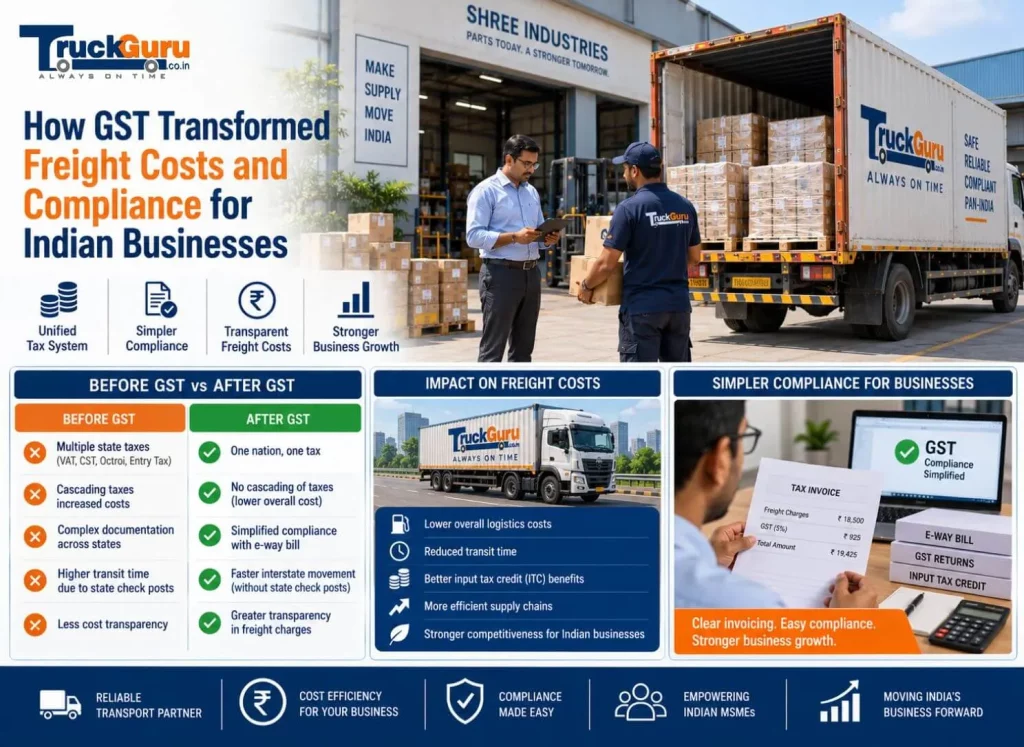
When GST came into force on 1 July 2017, it replaced a tax system that had been fragmenting Indian logistics for decades. State-level VAT, central excise duty, service tax, entry tax, and octroi — each collected differently, each needing separate documentation, each slowing goods at every state border. A truck moving from Gujarat to West Bengal had to cross multiple check posts and wait for tax verification at each one.
Impact of GST on Logistics: Quick Summary
The impact of GST on logistics in India: check posts removed, octroi abolished, e-way bills standardised, and how freight GST and ITC actually work now.
Seven years later, GST’s impact on logistics shows up in measurable ways: trucks cover more ground per day, border clearance runs faster, and organised freight operators have gained significant ground over informal ones. For businesses that regularly use intercity FTL transport, these shifts translate into lower total freight costs and more reliable delivery timelines.
This article explains the specific ways GST changed logistics operations in India — what improved, how the e-way bill system works, how GST rates apply to freight services, and where challenges remain.
What GST Replaced in the Logistics Sector
Before GST, a consignment crossing state borders carried compliance overhead across multiple tax systems. Each one created its own delays:
- VAT (Value Added Tax): a state-level tax with different rates and rules across every Indian state. Transporters operating pan-India had to track 29 separate VAT systems.
- Central Excise Duty: applicable on manufactured goods, adding a compliance layer at the production stage before goods even enter the logistics chain.
- Service Tax: applied to transport services at 14.5% on 30% of the freight value — effectively 4.35% of freight — under the pre-GST abatement scheme.
- Entry Tax and Octroi: local body taxes collected when goods cross into a city or state. Octroi check posts in Maharashtra and Gujarat routinely caused multi-hour truck delays. GST abolished both.
A single unified tax framework replaced all of these. For logistics operators, the most immediate change was the removal of state check posts and octroi nakas — the main source of inter-state transit delays.
Check Post Removal: The Single Biggest Operational Impact
No change from GST hit day-to-day logistics operations harder than the abolition of inter-state check posts. Before 2017, trucks had to stop at every state entry point for tax verification and documentation checks. Depending on the state, the queue and verification process added 2 to 8 hours per border crossing.
On a Delhi to Mumbai route via NH-48, a truck crossed Haryana, Rajasthan, Gujarat, and Maharashtra. Each check post added time. A journey that should take 22 to 24 hours often stretched to 30 hours or more.
Those delays have largely disappeared. Weighbridges and toll plazas still operate, but the documentation-based stops that caused most of the delay no longer exist. Industry estimates put the transit time reduction at 20 to 30 percent on major intercity corridors since GST.
For FTL intercity bookings, this means transit time estimates at the point of booking now hold. A Coimbatore to Ahmedabad run quoted at 17 to 20 hours consistently completes in that window. Before GST, check post variability made transit time estimates genuinely unpredictable.
The E-Way Bill System
Businesses now generate an e-way bill — a digital document on the GSTN portal — before any consignment moves. For consignments worth more than Rs. 50,000 crossing a state border (and for most intra-state movements above the same threshold), teams must generate the e-way bill before the truck leaves the pickup point.
Three specific changes matter for logistics:
Pre-movement generation
Under the old system, truck crews often completed documentation manually at check posts — which opened the door to errors, disputes, and delays. Now, businesses must generate the e-way bill before movement begins. A company moving machinery from Pune to Delhi cannot fill in approximate values and adjust later; the declared value and consignee details must be correct before the truck moves.
Validity based on distance
Each e-way bill carries a built-in expiry based on distance. Standard cargo gets one day of validity per 200 km. Over-dimensional cargo gets one day per 20 km. This builds transit-time accountability into the system — a truck that takes far longer than the validity window needs an extension, which flags unusual delays.
Transporter accountability
Every e-way bill records the transporter ID and vehicle number, creating a digital trail of which operator moved which consignment. This has improved accountability across the supply chain and cut the documentation disputes that were common under the manual check post system.
For step-by-step e-way bill generation instructions and validity calculation: e-way bill guide.
GST Rates on Freight and Transport Services
Knowing how GST applies to logistics services helps businesses calculate their true freight cost. The rate depends on whether a Goods Transport Agency (GTA) or an individual truck owner provides the service, and on whether the GTA claims Input Tax Credit (ITC).
For Goods Transport Agencies like TruckGuru
- 5% GST (without ITC): the most common rate for GTA services. Under the reverse charge mechanism (RCM), the registered business receiving the transport service pays the GST — not the transporter. GTAs cannot claim input tax credit on inputs at this rate.
- 12% GST (with ITC): GTAs that opt to pay at 12% can claim ITC on fuel, vehicle maintenance, and other inputs. This works better for operators with large input costs.
- 0% GST: applies when individual truck owners (not registered GTAs) transport goods. No GST on freight from an individual owner below a specified number of vehicles.
Practical implication for B2B shippers
A GST-registered manufacturing company booking FTL transport from a registered GTA at 5% under RCM can recover that 5% as input tax credit in most cases — reducing the effective freight cost. This ITC benefit did not exist cleanly under the pre-GST multi-tax system. For businesses that are not GST-registered or fall under exempt categories, freight GST becomes an additional cost.
Impact on FTL Intercity Freight
Intercity FTL operations show GST’s practical effects most clearly.
Route efficiency
Planners now base FTL route decisions mainly on road quality and distance rather than on which state borders have shorter check post queues. A Bangalore to Delhi booking no longer needs to account for how long Karnataka or Madhya Pradesh check posts run. Transit time estimates reflect distance and road conditions — both more predictable than bureaucratic processing time.
Documentation consolidation
Before GST, a truck crossing three states might carry Form 402 for Gujarat, Form 38 for UP, and various other state-specific transit documents alongside the basic LR and invoice. Post-GST, documentation for any inter-state FTL move follows one standard: GST invoice, e-way bill, and Lorry Receipt. Transporters need no state-specific transit forms beyond what GST mandates.
Octroi abolition in Gujarat and Maharashtra
Octroi had been one of the most disruptive local taxes for freight operators. Cities like Ahmedabad, Surat, Mumbai, and Pune ran octroi check posts where trucks entering the city paid a local levy and joined queues. GST replaced octroi with a compensatory grant mechanism that requires no truck stop. Urban freight movements in Gujarat and Maharashtra’s major cities now run without those checkpoint delays.
Shift Toward Organised Logistics Operators
One commercially significant impact of GST on logistics — less discussed than check post removal — is the shift from unorganised to organised transport operators.
Before GST, unorganised transporters who avoided filing taxes or maintaining proper documentation could undercut competitors on price, since they carried none of the compliance costs. E-way bill requirements changed this. Every consignment now needs a valid e-way bill that records the transporter ID, which means transporters must operate within the GST system to move goods legally.
B2B clients — manufacturers, distributors, and trading companies — now prefer organised operators with proper documentation, GST registration, and digital billing. Businesses that previously relied on informal transport arrangements have moved to platforms like TruckGuru that provide digital LR, GST-compliant invoicing, and confirmed rates.
Challenges That Remain
GST’s impact on logistics has been broadly positive, but not uniform. Several challenges persist:
- GSTN portal downtime: the e-way bill portal experiences periodic technical failures that delay generation before dispatch. Time-sensitive shipments feel this most acutely.
- Compliance costs for small operators: individual truck owners and small fleet operators who sat outside the formal tax system now face real compliance overhead — registration, GST filing, and digital documentation requirements that add to their costs.
- State-specific intra-state thresholds: the inter-state threshold sits at Rs. 50,000 across the board, but states set their own intra-state thresholds, and some apply lower limits for specific commodity categories.
- ITC restrictions on certain vehicle categories: GST restricts input tax credit on passenger vehicles. Logistics operators with mixed fleets need to categorise vehicles carefully for ITC eligibility.
How TruckGuru Operates Within the GST Framework
TruckGuru operates as a registered Goods Transport Agency on the FTL intercity network. Every booking produces:
- A GST-compliant freight invoice after delivery — with the correct HSN/SAC code for transportation services (SAC 9965)
- A digital Lorry Receipt at dispatch — recording the transporter ID and vehicle number for e-way bill compliance
- A confirmed rate at booking that covers any applicable GST — no revision after delivery
For businesses that need the transporter ID and vehicle number before the truck arrives — to generate the e-way bill on time — TruckGuru provides both at booking confirmation.
For confirmed rates on your route: freight calculator.
Frequently Asked Questions
What is the impact of GST on the logistics industry in India?
GST replaced multiple overlapping taxes — VAT, service tax, entry tax, octroi — with a single framework. Key operational impacts: state check posts abolished (cutting transit times by 20 to 30 percent), e-way bill system introduced in place of manual check post documentation, octroi abolished in major cities, and organised logistics operators have gained ground over informal ones.
What is the GST rate on freight charges in India?
Goods Transport Agencies charge 5% GST without Input Tax Credit, or 12% GST with ITC. Under the reverse charge mechanism at 5%, the registered business receiving the transport service pays the GST, not the transporter. Individual truck owners below a specified vehicle count are typically exempt from GST on freight.
What is an e-way bill, and when does logistics need one?
An e-way bill is a digital document generated on the GSTN portal before a consignment moves. Consignments above Rs. 50,000 crossing state borders need one. Most states also require it for intra-state movements above their own thresholds. Businesses must generate the e-way bill before the truck leaves the pickup location.
Has GST reduced logistics costs in India?
For organised logistics operations, yes. Fewer check post delays, abolished octroi, reduced documentation overhead, and ITC recoverability have all lowered effective freight costs for GST-registered businesses. Exact savings vary by route, volume, and ITC eligibility.
Did GST help small truck operators in India?
Results have been mixed. Organised small operators who register under GST and generate e-way bills now compete for B2B contracts that require documentation compliance — which was harder before. Informal operators who sat outside the tax system face real adaptation costs. Overall, formalisation has improved access to organised freight markets for operators willing to comply.
Conclusion
GST’s impact on the logistics industry in India has been structural, not superficial. Removing check posts, abolishing octroi, standardising documentation through e-way bills, and creating a unified tax framework have collectively made intercity freight faster, more predictable, and better documented than it was before July 2017.
For B2B businesses moving goods regularly on intercity FTL routes, the practical takeaway is this: transit time estimates hold more reliably, documentation follows one standard across all states, and freight GST is recoverable as ITC in most cases. Compliance challenges for smaller operators and GSTN technical issues remain, but the direction of change is clear.
For GST-compliant FTL freight with digital documentation: book at TruckGuru.co.in or call 72020 45678.
Related Reading
- How to Estimate Goods Transport Rates: A Beginner’s Guide
- How Are Truck Transportation Charges Calculated in India?
- 6 Truck Booking Platforms Compared for FTL Freight in India: FR8, WheelsEye, Trukky, BlackBuck, Vahak & TruckGuru
For current rules and official notifications, see the official GST portal.