

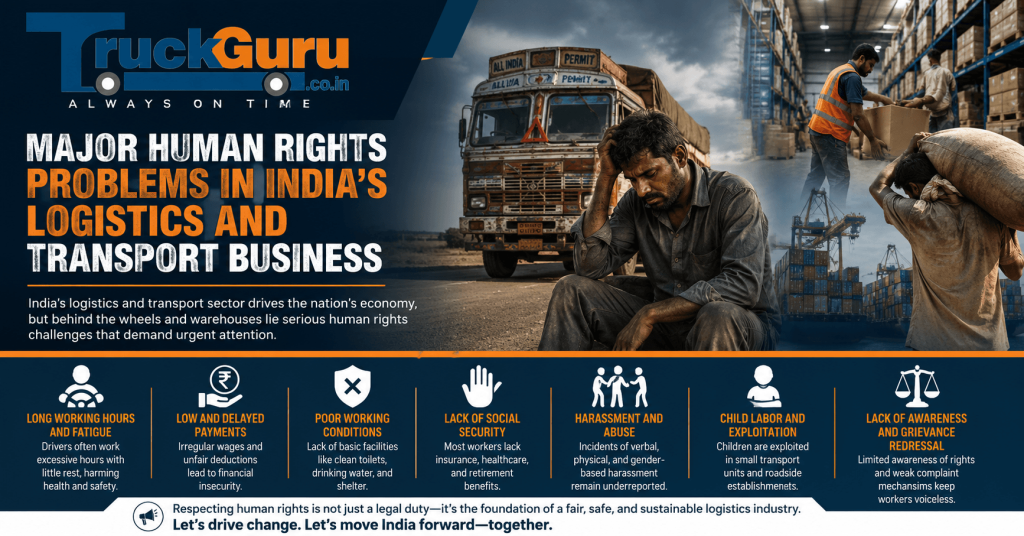
Human Rights in Logistics: What Buyers Now Audit in India
A pharmaceutical company in Ahmedabad sends its transport vendors a questionnaire. Forty questions. Recruitment practices, driver working hours, grievance channels, anti-bribery policy, who provides warehouse security and how they are trained.
Transport Business: Quick Summary
Transport Business: Learn how logistics companies can manage human rights risks, ensure compliance & build sustainable supply chains. Strengthen your.
Ten years ago that questionnaire did not exist. Now it decides whether a transporter keeps the contract.
That is the practical shape of human rights in logistics for an Indian business. Not a policy debate. A form that arrives from your largest customer, with a renewal date attached.
Why the questionnaire showed up
Two forces, and they compound.
The UN Guiding Principles on Business and Human Rights, adopted in 2011, made companies responsible for what happens across their supply chains rather than only inside their own payroll. Contractors, sub-contractors, third parties. For years,, that stayed voluntary.
Then it started hardening into law. The European Union’s Corporate Sustainability Due Diligence Directive requires companies with significant EU business to examine human rights and environmental impacts across their value chains, logistics providers included. If you export to Europe, or supply someone who does, that obligation travels down the chain to you.
Meanwhile,, large FMCG, pharmaceutical and manufacturing buyers built their own ESG reporting. They cannot report what their suppliers will not tell them. Hence the questionnaire.
Where the real risk sits: recruitment, not employment
Here is the part most transporters get wrong when they first face an audit. They answer the questions about their own staff, honestly and well, and still fail.
Forced labour rarely enters through a company coercing its own employees. It enters through the layer beneath: labour contractors, recruitment agents, the people who supply loading crews and warehouse hands on a daily-wage basis.
Agents recruit from Bihar, Jharkhand, Odisha and West Bengal. A worker may pay a fee to get the job. The agent may hold his documents until he has worked off that fee. The terms he was promised in his village may not match what he finds in Bhiwandi. The ILO indicators of forced labour name exactly this pattern: debt bondage, document retention, restricted movement.
None of that appears in your HR records, because those workers are not on your payroll. That is precisely why auditors ask about it.
The fix is unglamorous. Write into your contractor agreements that no fee may be charged to a worker and no document may be retained. Then check it yourself, by talking to workers rather than reading a contractor’s declaration. A contractor who objects to that clause has told you something useful.
Driver welfare, and the commercial logic nobody states
Long shifts. Poor rest stops. No provident fund, no health cover, informal employment throughout. This is well documented, and every operator in the country knows it.
What gets less attention is where the pressure originates.
A driver working unsafe hours is usually not the decision of the driver, or even of the fleet owner. It starts further up. A rate gets bid down below what the route can sustain. The operator takes it anyway, because an idle truck earns nothing. The margin has to come from somewhere, and it comes out of the driver’s rest.
So the shipper who squeezed the rate by eight percent and the shipper auditing driver welfare are frequently the same company, and often the same month.
If you buy freight, the honest question to ask yourself is whether your rate leaves room for the standards your questionnaire demands. That is a harder question than any on the form.
The audit questions that actually get asked
Having seen a few of these, the pattern is consistent. Buyers concentrate on what they can verify.
- Grievance mechanisms. The UN Guiding Principles require access to remedy, and this is the item auditors probe hardest, because it is testable. Not whether you have a policy. Whether a loading worker who speaks Bhojpuri and has no smartphone can actually raise a complaint and get an answer. Most mechanisms fail on accessibility rather than on intent.
- Anti-bribery. Logistics runs through toll booths, checkposts, permit offices and customs points, and everyone knows what happens at some of them. Paying carries legal risk under the Prevention of Corruption Act. Auditors want a written policy, staff trained on how to refuse, and a channel to report pressure. They also know a policy alone changes nothing at a checkpost at midnight.
- Contracted security. Warehouse and yard security is nearly always outsourced, and the conduct of those guards reflects on the principal, not the contractor. The Voluntary Principles on Security and Human Rights are the standard framework. Assess your security supplier against them and put the requirement in the contract.
- Very few women work across most roles in Indian logistics. Buyers ask about pay transparency, harassment reporting that functions, and recruitment. Caste discrimination in hiring belongs in this conversation too, named explicitly in HR policy rather than folded into general equal-opportunity wording.
The risks that sit further from your control
Two deserve mention, though a mid-sized transporter influences them less directly.
Communities near freight corridors and warehousing clusters carry the pollution burden. Bhiwandi, the Manesar corridor, the port-adjacent zones in Chennai and Mumbai. Fleet maintenance and route planning that keeps heavy traffic out of dense residential streets are the levers an operator actually holds.
Land acquisition for warehousing clusters and logistics parks affects communities with limited legal standing. Free, prior and informed consent is the international standard, and in practice it means engaging before the decision, giving accurate information, and compensating for livelihoods rather than only for land area.
Neither is something a transporter solves. Both appear in the questionnaires of buyers who develop infrastructure themselves.
What changed after 2020
The pandemic settled an argument. When operations stopped, large numbers of contract workers in logistics were left without wages or a way home. Formal contracts, ESIC and EPFO registration, and some emergency provision stopped being a welfare debate and became a continuity one.
The buyers noticed too. Migrant worker protection now appears on questionnaires that did not carry it in 2019.
How TruckGuru Fits
TruckGuru runs an intercity FTL truck booking platform connecting B2B shippers with truck operators across India. Four things about how it works bear on the risks above.
The rate is confirmed before dispatch, which removes the after-the-fact squeeze that pushes drivers into unsafe hours. Documentation is digital, covering the LR, GST invoicing and e-way bill support, and a formal paper trail displaces the informal arrangements where exploitation hides. Dispatched bookings carry GPS tracking. The platform reviews operator registration and compliance documents before a vehicle takes work.
For freight enquiries, call +91-7202045678, check a rate on the freight calculator, or book a truck online. For the documentation and verification checks worth running on any transport partner, see choosing a transport service provider.
Frequently Asked Questions
What are the biggest human rights risks in Indian logistics?
Forced labour entering through labour contractors and recruitment agents rather than direct employment. Driver welfare, particularly hours and health cover. Weak or inaccessible grievance mechanisms. Pressure for informal payments at regulatory touchpoints. Under-representation of women and caste discrimination in hiring.
What are the UN Guiding Principles?
Adopted in 2011, they make companies responsible for respecting human rights across their operations and supply chains, not only among direct employees. For a transporter, that extends to contractors, sub-contractors and labour suppliers.
How do I prevent forced labour in my supply chain?
Write it into contractor agreements: no recruitment fee charged to a worker, no document retention. Then verify it by speaking to workers directly rather than accepting a contractor’s declaration. Give employment terms in writing in a language the worker reads.
What does a buyer’s ESG audit actually check?
Whatever it can verify. Grievance channels that a worker could genuinely use, a written anti-bribery policy with training behind it, the standards applied to contracted security, and recruitment and pay practices. Policies without evidence of use score poorly.
Does this apply to a small transport business?
If you carry freight for a company that exports to Europe or reports on ESG, yes, indirectly. The obligation travels down the chain through their supplier requirements, and it arrives as a questionnaire rather than a law.
What is a grievance mechanism?
A channel where workers, drivers, contractors and community members raise concerns and get a response. It works only if people can use it: right languages, usable without a smartphone or high literacy, anonymity where needed, and real follow-through.
Where this is going
The direction is clear enough. Requirements that arrived as voluntary standards became buyer questionnaires, and some are becoming law. A transporter who can answer the questionnaire honestly today will find the next round easier.
The ones who will struggle are those who answered it well and changed nothing underneath.
Related Reading
- How to Estimate Goods Transport Rates: A Beginner’s Guide
- How Are Truck Transportation Charges Calculated in India?
- 6 Truck Booking Platforms Compared for FTL Freight in India: FR8, WheelsEye, Trukky, BlackBuck, Vahak & TruckGuru
For current rules and official notifications, see the Ministry of Road Transport & Highways.