

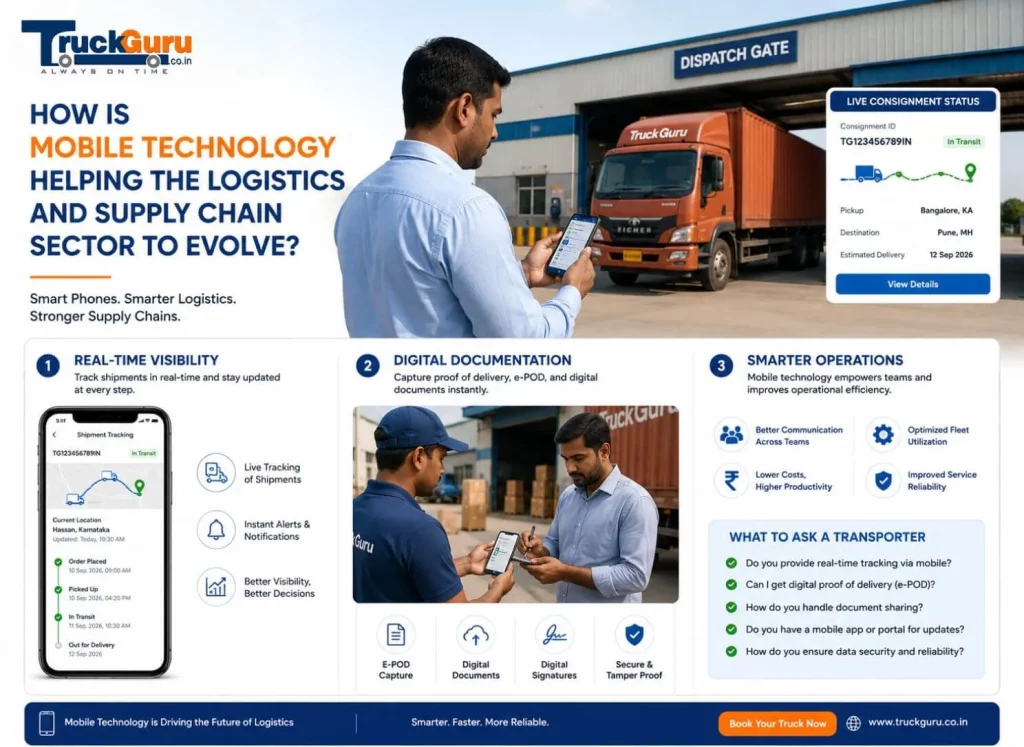
Every transport company now has an app, and each will show it to you. Very few of those demonstrations answer the question that matters: whether anything about your consignment improves.
Mobile technology in logistics is sold hard and delivered unevenly. This is a short guide to separating the two from the shipper side.
Mobile Technology in Logistics: What Actually Helps You
Four things, in the order they affect your business. Everything else in a mobile technology in logistics pitch is secondary to these.
- Documentation captured where it happens. A proof of delivery captured electronically at the receiving gate, with the relevant time and shipment information attached, is easier to retrieve and verify than a paper copy that reaches an office a week later. Damage disputes turn on when damage was recorded, so this is the feature with the clearest financial value to you.
- A booking record you can refer back to. Vehicle type, route, rate and inclusions in one place. Six weeks later when a bill is queried, you are reading a record rather than reconstructing a phone call.
- Status without a phone call. Knowing where a vehicle is matters less for the information itself than for what it removes: the chain of calls between you, the transporter and the driver every time your receiving plant asks.
- Traceable payment and a GST invoice. Not glamorous. A proper GST invoice gives your finance team the documentation needed for GST accounting and any eligible input tax credit claim, and it is the paper trail you rely on if something goes wrong.
Which Logistics App Features Matter Most?
If you are comparing operators on their technology, these are the features that change something for you, roughly in order of usefulness.
- Digital proof of delivery. Captured at the receiving end, retrievable without chasing anyone. The one feature that directly affects whether a damage claim succeeds.
- Digital LR and document access. Being able to pull the consignment note and delivery record yourself, rather than requesting them and waiting.
- Booking history. Past movements, rates and routes in one place. This is what makes rate comparison over time possible at all.
- Shipment tracking. Useful for coordinating with your receiving location and for cutting the phone calls. Judge it on whether the status is current, not on how the map looks.
- Invoice and GST document access. Straightforward, and the thing your finance team will actually use every month.
- Status updates you do not have to request. A notification on dispatch and delivery removes more friction than any dashboard.
A long feature list matters less than whether the information is accurate, accessible and current while a shipment is moving.
What Does Not Help as Much as the Demonstration Suggests
- A map with a moving truck on it. Satisfying to look at, and it does not change transit time. A vehicle stuck at a weighbridge is stuck whether or not you can watch it.
- Dashboards and analytics for a shipper moving a handful of consignments a month. There is not enough data to analyse, and the screen is doing marketing work rather than operational work.
- Route optimisation presented as your benefit. It primarily serves the operator through fuel and fleet efficiency, though you gain where it genuinely reduces avoidable transit time or improves delivery reliability. Ask which of those it does for your route.
- Anything described as visibility without a specific answer to what you will see and when.
Questions Worth Asking a Transporter
These take two minutes and tell you more than a product demonstration.
- What exactly will I be able to see about my consignment, and from what point in the journey?
- How is proof of delivery captured, and how quickly do I get it?
- Will I receive a written booking record with the rate and inclusions stated before loading?
- Who do I contact when a vehicle is delayed, and is it a named person or a general line?
- What payment methods are accepted, and do I get a GST invoice on every movement?
A transporter who answers all five plainly is worth more than one with a better-looking app and vague answers. Technology on the operator side is only useful to you where it produces something you can hold: a document, a record, an answer.
What Technology Does Not Replace
The consignment note or LR remains the key transport document recording the movement and its terms, issued at loading. Check the consignee, package count, declared value and condition of goods at the gate, because corrections take two minutes there and are close to impossible afterwards. E-way bill requirements under GST apply independently of any app, with applicable GST and e-way bill rules set out on the e-way bill portal.
And insurance is still a separate question. A booking record is not transit cover. Ask what insurance cover applies to the consignment, what exclusions or limits apply, and who is responsible for the policy, in writing, before loading.
Where TruckGuru Fits
TruckGuru provides full truckload intercity transportation across 110+ cities in India, with upfront freight pricing and the vehicle type, route and rate stated before loading. Toll is included in the quoted fare rather than added at delivery. Dispatched bookings carry live GPS tracking, and digital documentation includes the LR and delivery records, with GST invoicing and e-way bill support applied where relevant. Payment is staged across confirmation, loading and delivery. You can book a truck online or use the mobile app to manage bookings and track active shipments.
For a shipper, that is the test this article has been describing. The technology is doing something when it produces a confirmed booking record, shipment visibility, a digital document or a clear status update.
The operator side of this question, load discovery and fleet software, is covered in mobile apps for logistics. For how vehicle tracking works and what is legally required on Indian commercial vehicles, see GPS tracking for intercity freight. If you are assessing a transporter more broadly, the verification checks are in choosing a transport service provider.
Key Takeaways
- Judge mobile technology in logistics by what it produces for you: a document, a record, an answer.
- Documentation captured at the point it happens has the clearest financial value, because damage claims turn on when damage was recorded.
- A live map is satisfying and does not change transit time.
- Ask five specific questions rather than watching a product demonstration.
- No app replaces the consignment note, the e-way bill or transit insurance.
- A plain answer about proof of delivery beats a better-looking interface.
Frequently Asked Questions
What mobile technology should a transport company have?
Enough to give you a written booking record before loading, proof of delivery captured at the receiving end, a status answer without a chain of phone calls, and a GST invoice on every movement. Beyond that, most of what is demonstrated benefits the operator rather than you.
Is shipment tracking actually useful for a shipper?
It is useful for removing phone calls and for coordinating with your receiving location. It does not shorten transit or prevent delays. Treat it as a communication tool rather than a performance improvement.
What should I ask a transporter about their app?
What you will see and from what point, how proof of delivery is captured and how fast you get it, whether the booking record states rate and inclusions before loading, who you contact when a vehicle is delayed, and whether every movement produces a GST invoice.
Does an app replace the consignment note?
No. The consignment note or LR remains the contract of carriage and is what any damage or loss claim rests on. A booking record is not a substitute.
Is my consignment insured because it was booked digitally?
No. Transit insurance is a separate arrangement. Ask what cover applies, for what declared value, and who holds the policy, and get the answer before loading.
Do I need to generate the e-way bill myself?
Responsibility depends on the arrangement between consignor, consignee and transporter. Confirm who is generating it for your movement, and check current thresholds and state rules rather than assuming.
What logistics app features should a shipper look for?
Features that produce useful operational information: shipment tracking, a documented booking record, digital proof of delivery, access to transport documents and clear status updates. A long feature list matters less than whether the information is accurate, accessible and useful while a shipment is moving.
Is a bigger transport company likely to have better technology?
Often, though it matters less than whether they answer the five questions above plainly. A regional operator with clear documentation practice usually serves you better than a large one with a good interface and vague answers.
The Short Version
Ask what you will actually receive and when. If the answer is a document, a record or a straight answer to a question you would otherwise have to chase, the technology is doing something. If the answer is a screen, it is doing marketing.