

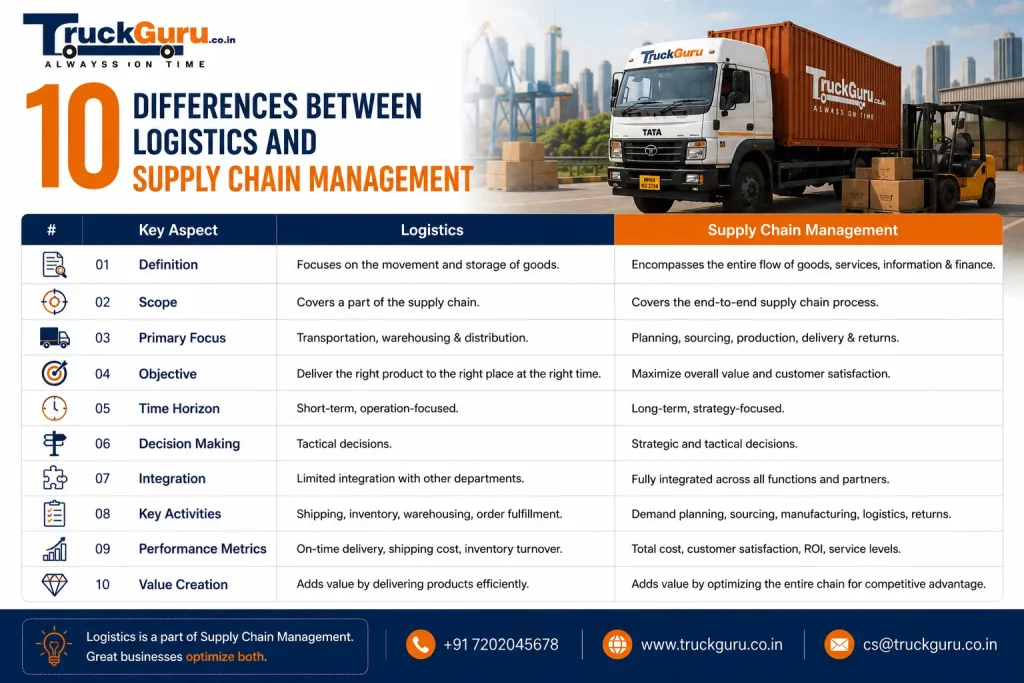
10 Differences Between Logistics and Supply Chain Management
Logistics and supply chain management get used interchangeably in most business conversations. That is a problem. Treating them as the same thing creates blind spots — a business focused only on logistics execution will keep missing upstream inefficiencies it cannot see from the ground level.
Logistics vs Supply: Quick Summary
Logistics vs Supply: Logistics and supply chain management are not the same. Learn the 10 real differences with practical examples for Indian manufacturers.
This article draws a clear line between the two. What each covers, where they interact, and why the difference matters practically, if you are moving commercial goods in India.
Why the Distinction Matters for Indian Businesses
India’s intercity freight market is large and fragmented. Manufacturers shipping from Ahmedabad to Mumbai, or distributors moving FMCG stock from a Delhi warehouse to Hyderabad, are dealing with logistics decisions every week. But the upstream decisions — which supplier to use, how much stock to hold, where to position inventory — are supply chain decisions that get made months earlier.
When those two planning layers are confused, businesses overbuy inventory, park trucks in the wrong cities, or lock in supplier contracts that make last-mile delivery unnecessarily expensive. Getting the terminology right is the first step to getting the operations right.
What Is Logistics Management?
Logistics is the operational process of planning, managing, and controlling the movement and storage of goods from the point of origin to the destination. It is the function that determines whether a consignment leaves on time, travels safely, and arrives in acceptable condition.
Core activities under logistics: transportation, warehousing, inventory management, packaging, material handling, and order fulfilment. For an e-commerce seller, logistics is what the customer actually experiences. Delayed delivery, wrong item, damaged packaging — those are logistics failures at the point of execution.
For businesses moving goods intercity by truck, logistics decisions come down to vehicle choice, route, transit time, and lead time for booking. The freight rate calculator on TruckGuru shows live trip rates for intercity FTL movements before you commit to a booking.
What Is Supply Chain Management?
Supply chain management (SCM) covers the entire flow of goods and services from raw material sourcing through production, warehousing, distribution, and final customer delivery. It is coordination across multiple organisations — not just one team managing one leg of one shipment.
Logistics is one function within SCM. Procurement, demand planning, production scheduling, and distribution network design all sit outside logistics but directly shape what logistics has to execute. A supply chain problem showing up as a logistics failure often starts several steps back.
Logistics vs Supply Chain Management: At a Glance
Logistics | Supply Chain Management |
Operational focus | Strategic focus |
Operates within one organisation | Spans multiple organisations |
Moves and stores goods | Plans and optimises the entire value chain |
TMS and WMS technology | ERP, demand planning, RFID across parties |
Managed by Logistics Manager | Managed by Supply Chain Manager |
Military origins, centuries old | Coined by Keith Oliver, early 1980s |
10 Key Differences Between Logistics and Supply Chain Management
1. Scope
Logistics covers transportation, storage, packaging, material handling, and information flow within a single operation. SCM covers procurement, production planning, manufacturing, distribution, logistics, and customer service across multiple organisations. Logistics is a function inside SCM — not equivalent to it.
2. Primary Purpose
Logistics exists to get goods to the right place on time. SCM exists to optimise the entire value chain for cost, speed, and competitive positioning. One is about execution. The other is about architecture.
3. Working Cycle
The logistics cycle covers supply management, distribution management, production management, and reverse logistics. The SCM cycle covers demand forecasting, sales and operations planning, product portfolio management, and supplier coordination — typically across multiple organisations simultaneously, not just within one.
4. Accountability
A logistics team is accountable for the physical movement and storage of goods within a defined operation. An SCM team is accountable for the full transformation from raw material to finished delivery — every organisation in the chain between origin and customer.
5. Organisations Involved
A logistics function typically operates within one company. SCM spans suppliers, manufacturers, intermediaries, distributors, and customers. Multi-party by definition. Getting alignment across all of them is most of the job.
6. Operational vs Strategic
Logistics is operational: scheduling, routing, loading, transit tracking, and proof of delivery. SCM is strategic: network design, supplier selection, demand planning, risk management. Both require different skills, different timelines, and different decision-makers.
7. Key Benefits
Good logistics reduces delivery delays, lowers transport cost per consignment, and improves fill rates. Good SCM reduces input costs through better supplier terms, improves cash flow through inventory optimisation, and manages supply disruption before it becomes a logistics problem. One fixes what happens in transit. The other prevents the problems from arising.
8. Historical Origin
Logistics has military origins. The discipline evolved from managing troop supply lines and equipment movement across campaigns — some historians point to Alexander the Great’s campaigns as early examples of logistics planning at scale. SCM as a business concept is much more recent. Keith Oliver, a consultant working with Philips in the early 1980s, coined the term when mapping how integrated supply chains could outperform disconnected ones.
9. Technology Used
Logistics uses Transportation Management Systems (TMS) and Warehouse Management Systems (WMS) to handle scheduling, routing, and fulfilment. For smaller businesses moving FTL intercity freight, a truck booking app covers scheduling and documentation without a full TMS setup. SCM uses broader platforms — ERP systems, demand planning tools, RFID tracking — often linking multiple organisations through shared data.
10. Professional Roles
A Logistics Manager handles transportation and delivery, warehouse operations, and carrier relationships for one organisation. A Supply Chain Manager handles supplier relationships, production coordination, demand planning, and strategic network design across multiple parties. The Logistics Manager executes within the structure that the Supply Chain Manager builds.
How Logistics and Supply Chain Management Work Together
SCM sets the structure. Logistics executes within it. A well-designed supply chain with poor logistics will fail at the delivery point — which is the only point customers see. Strong logistics without SCM alignment can fulfil orders efficiently, but may be drawing from the wrong inventory at the wrong locations.
For Indian manufacturers and eCommerce businesses, this plays out in a specific sequence. Demand forecasting determines what inventory goes where. Supplier planning determines when it arrives at the warehouse. Logistics determines whether it moves to the customer on time. Break any link, and the chain fails at the point closest to the customer.
On high-volume corridors like Delhi-Mumbai or Ahmedabad-Mumbai, matching the right vehicle to your consignment weight is one of the most direct logistics levers available. The truck size guide covers TruckGuru’s fleet from the Tata Ace (750 kg) up to a 32ft container (16T) with rate ranges for each. Booking the wrong size — either undershooting and running multiple trips or overshooting and paying for unused capacity — is a logistics decision that affects your transport cost per unit directly.
Q3 and Q4 consistently put the most pressure on intercity freight in India. Festive season demand spikes hit logistics hard. The businesses that handle it well usually make their SCM decisions in Q1 and Q2 — where to position stock, which corridors to prioritise, and how much buffer to hold. The ones scrambling for trucks in October made those decisions too late.
Common Challenges When Logistics and SCM Are Not Aligned
- Inventory is in the wrong warehouse for the demand that actually arrives
- Transport bookings are made too late because SCM did not share the forward demand data
- Supplier delays hit logistics with no buffer time built in upstream
- Cost overruns at the logistics layer that could have been avoided with better SCM planning
- Reverse logistics — returns, rejections, redeliveries — are handled reactively instead of being planned for
Best Practices for Indian B2B Shippers
- Separate your logistics planning cycle from your SCM planning cycle — they operate on different timelines
- Share forward demand data with your transport partner at least 2-3 weeks ahead on high-volume corridors
- Use rate calculators before committing to booking — intercity rates vary by corridor, vehicle type, and season
- Plan for Q3/Q4 freight demand in July, not September
- Audit your inventory positions quarterly to catch SCM decisions that are making logistics more expensive than they need to be
How TruckGuru Supports Your Intercity Logistics
TruckGuru operates FTL intercity truck booking for commercial goods shipments across India. The platform is built for B2B shippers — manufacturers, distributors, traders — moving goods between cities on dedicated vehicles.
Five vehicle sizes cover most intercity FTL requirements: Tata Ace (750 kg load capacity), Bada Dost (1.5T), 14ft Eicher (3.5T), 20ft truck (6.5T), and 32ft container (16T). Rates are shown as full trip cost before booking — no formula to work out manually. Check the online truck booking page for live availability on your corridor.
For businesses that need regular corridor coverage — factory to distributor, warehouse to branch — the logistics service page covers how TruckGuru handles repeat FTL bookings for commercial shippers.
Frequently Asked Questions
What is the main difference between logistics and supply chain management?
Logistics handles the physical movement and storage of goods — it is the operational execution layer. SCM covers everything from raw material sourcing through production, distribution, and delivery, with logistics as one component within it. SCM is the broader strategic discipline. Logistics is how the strategy gets executed on the ground.
Is logistics part of supply chain management?
Yes. Logistics is one core function within SCM. A supply chain cannot operate without logistics, but SCM also includes procurement, production planning, demand forecasting, and supplier management — none of which are logistics functions.
Which matters more for an e-commerce business moving goods intercity?
Both, but at different stages. Your SCM decisions determine what inventory is where and at what cost. Your logistics decisions determine whether that inventory reaches the customer on time. For intercity FTL freight specifically, logistics is the day-to-day concern — vehicle booking, transit time, proof of delivery. But poor SCM shows up in your logistics costs eventually.
Why do people confuse logistics and supply chain management?
Both involve moving goods, and both affect delivery timelines. In casual conversation, the terms blend. In operations, they are distinct enough that separating them leads to better planning. SCM is where the network gets designed. Logistics is where goods actually move through that network.
How does poor logistics affect the supply chain?
Logistics failures create downstream disruption immediately: stockouts, delivery delays, damaged goods, and increased costs. Since logistics is the execution layer, a breakdown here flows through to customer satisfaction, return rates, and inventory replenishment cycles across the entire chain.
What technology is used in logistics vs SCM?
Logistics uses TMS (Transportation Management Systems) and WMS (Warehouse Management Systems) for scheduling, routing, and fulfilment tracking. SCM uses broader ERP platforms, demand planning tools, CRM systems, and RFID tracking — often linking multiple organisations through shared data infrastructure.
Can a small manufacturing business manage both logistics and SCM effectively?
Yes, but they operate on different timelines and usually need different people or partners. Logistics can be outsourced to a transport provider for the execution layer. SCM decisions — supplier selection, inventory positioning, demand planning — sit with the operations head or business owner and require a longer planning horizon.
Industry Trends Reshaping Both Functions in India
- Digital freight platforms are reducing the gap between SCM planning and logistics execution — shippers can now access real-time rate data before finalising supplier and inventory decisions
- E-way bill compliance requirements are making documentation a logistics function that feeds back into SCM reporting
- GST-driven supply chain restructuring, shifting warehouse locations from state-border avoidance logic to demand-proximity logic
- Real-time shipment visibility is becoming table stakes for B2B shippers managing multi-leg intercity movements
- FTL vs PTL decisions are becoming more data-driven as per-trip rate calculators give shippers a clear cost comparison before booking
Conclusion
Logistics and supply chain management are not competing ideas — they operate at different levels of the same system. SCM builds the network. Logistics runs goods through it. Getting one right without the other leaves gaps that show up as delivery failures, inventory overruns, or transport costs that are higher than they need to be.
For businesses moving commercial goods intercity in India, the logistics layer is where the daily decisions happen — vehicle size, booking lead time, corridor rates, transit expectations. The supply chain layer is where those decisions get set up to succeed or fail.
If you want to see what intercity FTL freight actually costs on your corridor before committing to a booking, the TruckGuru freight calculator gives live rate estimates across five vehicle sizes. No formula, no call required — just enter your route and load.
Related Reading
- Reduce Manufacturing Freight Costs: India Intercity Guide
- Reduce B2B Freight Costs in India: 25 Proven Strategies
- Ship-To GSTIN Mandate August 2026 — What Shippers Must Do
For current rules and official notifications, see the Ministry of Road Transport & Highways.