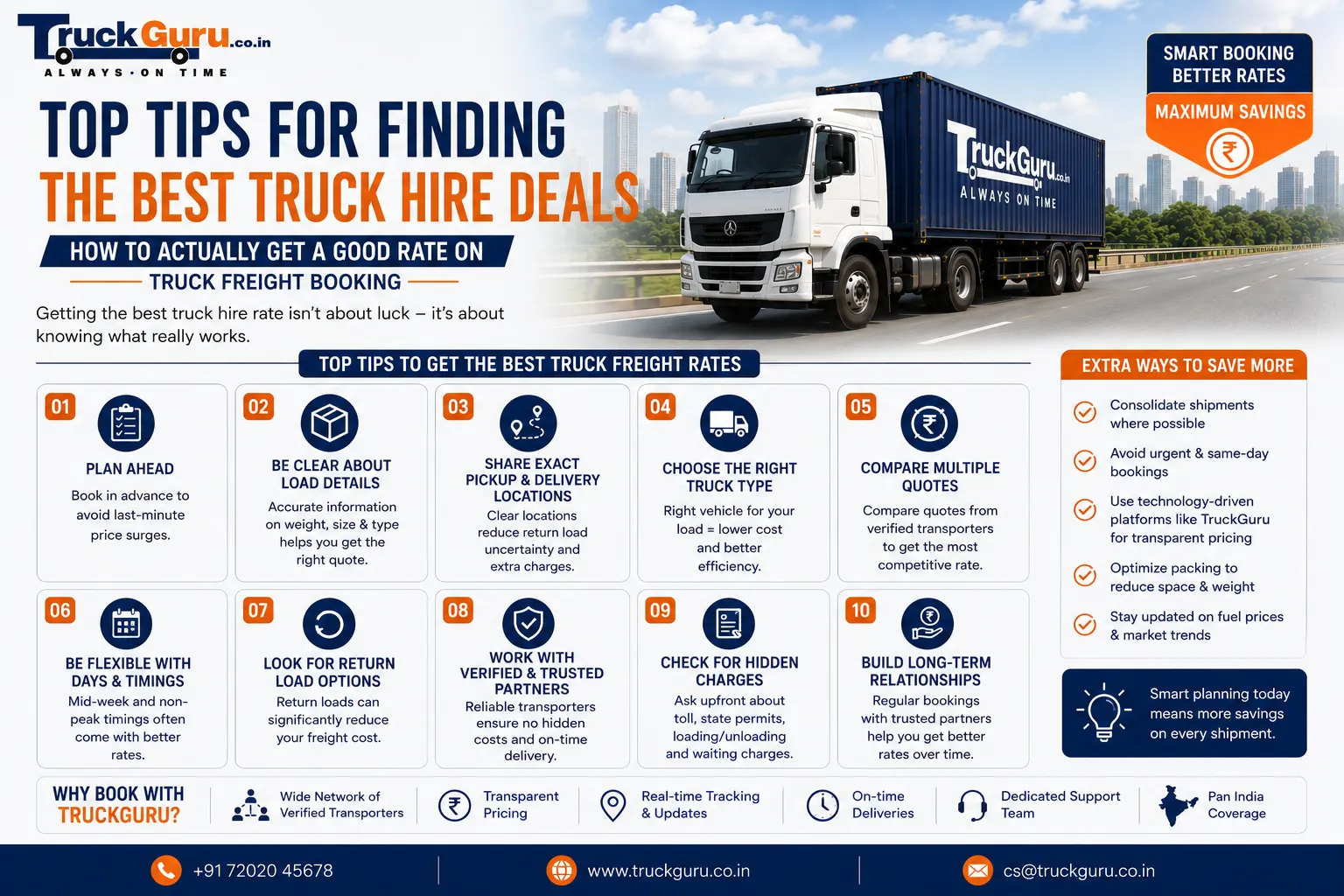
How to Actually Get a Good Rate on Truck Freight Booking
Most “truck hire deals” advice online is written for someone moving house — matching truck size to apartment size, negotiating a weekday discount, asking if there is a secret promotion the company is not advertising. None of that applies to booking FTL freight for a business, because the entire pricing model works differently: there is a published rate, the same number for every customer on that route and truck size, with nothing to negotiate.
That sounds like it removes the question this article is supposed to answer, but it does not — it just moves the real cost-saving opportunities somewhere else. Here is where they actually are.
Why “Ask for a Better Deal” Does Not Apply Here
On a fixed-rate platform, the number quoted before booking is the number on the invoice after delivery. There is no negotiation step, no day-of-week pricing variation, and no unadvertised promotion to ask about, because the rate does not move based on any of that. This is a different kind of value than an occasional lower negotiated price — it is the absence of price uncertainty, which, for a business budgeting freight costs, is usually worth more than a number that might sometimes be lower but is never predictable in advance.
Where Your Actual Cost Control Lives
Book the right truck size for your actual cargo weight
This is the single biggest lever, and it has nothing to do with negotiating. A 32ft container booked for a 4-tonne load pays full container-truck rates for capacity that never gets used. Weigh the shipment and match it to the smallest category that covers it — Tata Ace, Bada Dost, 14ft, 20ft, or 32ft container — rather than booking larger “to be safe.”
Full specifications: truck size guide.
Consolidate partial loads instead of booking separately
Three partial loads to nearby destinations mean three separate base charges. Combined into fuller bookings on overlapping routes, that becomes fewer trips for the same total cargo — a direct saving that has nothing to do with finding a better quoted price and everything to do with not paying for the same fixed cost three times over.
Book ahead for availability, not for a lower price
On a fixed-rate platform, booking early does not unlock a discount the way it sometimes does in negotiated markets — the rate is the same whether you book a month ahead or the day before. What booking ahead does affect is availability, particularly during peak shipping periods when trucks on popular corridors get booked up. Plan to secure a truck, not because the price will be different.
Confirm the quoted number is genuinely the final one
This is worth checking with any transporter, not just because of how TruckGuru works specifically. Ask directly whether fuel, tolls, loading charges, or insurance get added after the fact, and get the answer in writing before booking. On TruckGuru, the rate shown at booking is the rate on the invoice — no separate additions once the truck is loaded — but that is worth verifying with any provider, since “extra costs added later” is a genuine and common problem in less transparent parts of the trucking market.
Sort documentation before the truck leaves, not after
A surprise e-way bill requirement or missing transporter ID discovered at a state border can cost more in delay than any rate difference would have saved. Confirm vehicle and transporter details at booking so documentation can be prepared in advance rather than scrambled together at the last minute.
How This Compares to Traditional Broker Booking
With a traditional broker-based transporter, negotiation genuinely is part of how pricing works — a verbal quote, some back-and-forth, sometimes a lower number for repeat business or off-peak timing. That is a legitimate model, and the advice to compare quotes and ask about discounts is sound advice for that specific market. It simply describes a different transaction than booking on a published rate card, where the price is set before you ever ask. Neither model is universally better; they just put the cost-saving lever in different places. On a negotiated market, the lever is in the conversation. On a fixed-rate platform, the lever is entirely in your own planning — truck size, consolidation, and documentation — since there is no conversation to have about the number itself.
What “Good Value” Actually Means on a Fixed-Rate Platform
The honest version of “getting a good deal” here is avoiding the mistakes that inflate cost regardless of what the published rate says — the wrong truck size, a half-empty truck, a documentation scramble that delays a shipment. None of these shows up as a number you could have negotiated down; they show up as costs you added to a correctly-priced booking through an avoidable error on your own end.
Check a confirmed rate for your route on the freight calculator.
Closing Thoughts
A fixed-rate platform trades the chance of an occasional lower negotiated price for the certainty of knowing the cost before the truck leaves. For a business budgeting freight regularly, that trade is usually the better one — and the real cost control that remains is entirely in your hands: the right truck size, full loads, and documentation sorted in advance.
Frequently Asked Questions
Can I negotiate a better rate on TruckGuru?
No. The published rate for a route and truck size is fixed and the same for every customer — there is no negotiation step. The cost control that does exist is in choosing the right truck size and consolidating shipments, not in negotiating the quoted number.
Does booking a truck early get me a discount?
No, not on a fixed-rate platform — the price does not change based on when you book. Booking ahead helps secure availability during busy periods, which is a different benefit from a lower price.
Are there hidden fees added after booking a truck on TruckGuru?
No. The rate confirmed at booking is the rate on the invoice after delivery. If you are evaluating a different transporter, ask this question directly and get the answer in writing before booking.
What is the most effective way to reduce truck booking costs for a business?
Match the truck size to your actual cargo weight rather than booking larger than needed, and consolidate partial loads into full bookings where routes overlap. Both reduce cost directly, independent of the published rate itself.
Call 72020 45678 or book online at truckguru.co.in for a confirmed rate on your next shipment.